You Don't Own Physical Media, Either
On Sony, physical games, and imagining a future of collective ownership.
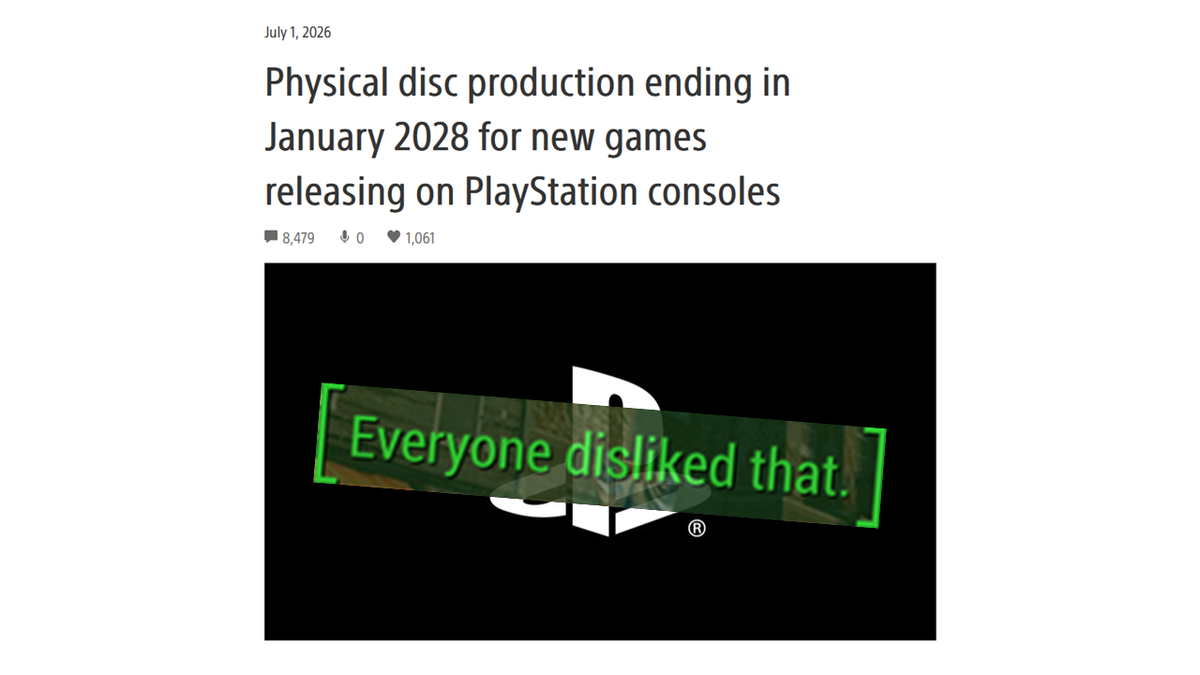
**UPDATE 2026-07-28** Check out this action item if you're a PlayStation 5 owner. TL;DR, stop updating your console now by turning off automatic updates.
The End of Physical Media?
I recently started replaying The Legend of Zelda: Ocarina of Time 3D for the Nintendo 3DS. I can do this because I have in my possession a modded 2DS XL and my physical copy of the game from when I was a teenager. I've sold many of the games from my youth for some extra cash here and there, but the more I learn about where this world is going, the more I cling to my physical media. I've even started rebuilding my collections of games and music, sometimes buying physical copies of games I've already purchased digitally just so I know I'll have them forever.
This past month has been rough for gamers. Xbox is laying off 3,200 workers. Consoles, which used to decrease in price over time, are only going up in price. Valve's Steam Machine, a supposed "best of both worlds" between PC and console gaming, was announced to cost $1,049 without a controller. GTA VI was revealed to cost $79.99 with significant in-game content locked behind an additional $20 paywall, somewhat confirming fears that the game would cost $100. All of this is leading more people to be priced out of a beloved hobby.
The big news story of the summer, however, comes from Sony, who announced on July 1st that they would no longer be manufacturing physical discs of their games after January 2028. As a collector of physical media myself, this is deeply upsetting to hear. I'm sure if you're subscribed to this blog, you're concerned enough about the state of technology to where you understand the consequences of having art as digital-only; no selling your used games for cash, no buying used games for cheap, no libraries keeping copies of games to rent, games being able to be changed to remove content such as licensed music (and in at least one case, an entire voice actor's work), games being able to be removed from users' libraries at the publisher's whims...I could go on.
What concerns me most is what this means for the future of games as an artistic medium. For one, many gamers (including young kids) often rely on the second-hand market and libraries to save money on games in what is quickly becoming a deeply expensive hobby. Games on Sony's digital marketplace seldom go on sale, meanwhile you can find great deals in thrift stores or trade physical games with friends. (I scored copies of The Last of Us' PS5 remaster and Until Dawn for PS4 for $20 and $10 respectively this way, while both were still full price for $70 and $20 on the PlayStation store!) In 10 years, there will be no "used" copies of any recent PlayStation games, so the entire market will contract as fewer people get into the hobby and newer gamers spend all their money on Fortnite skins or Robux instead of expanding their tastes with smaller, experimental games. It's also bad for games preservation, as games can just go away forever; Video Game Foundation estimates that 87% of classic games are "critically endangered" and unavailable through official platforms. Games are art, important art at that, so for one company to have a monopoly on the distribution of that art is deeply troubling.
These issues are not hypothetical. On the very same day that Sony announced that they would be stopping disc production, Sony announced that it would be closing the online stores for the PS3 and PS Vita. Just days before, the company also announced that 551 movies and television titles from StudioCanal, Europe's leading film distributor, that people had purchased via the PlayStation Network would no longer be accessible to users. The legalese that makes this possible is contained within Sony's Terms of Service, Section 10.1, which basically says that our colloquial usage of the term "own" does not apply...
Use of the terms “own,” “ownership,” “purchase,” “sale,” “sold,” “sell,” “rent,” or “buy” in this Agreement or in connection with PSN Content does not mean or imply any transfer of ownership of any content, data or software or any intellectual property rights from SIE, its affiliates or its licensors to any user or third party.
Now, it obviously makes sense for companies to make decisions that save them money. In his video on the subject, noted game industry reporter Jason Schreier outlined the finances of disc production, explaining that it is not cheap to a) manufacture discs and b) give brick and mortar retailers a cut of the profits on each game sale. Sony is a company that needs to make money, what's the big deal? As Schreier points out, the "big deal" is that this value is not being passed on to the consumer; when buying digitally, game buyers do have the convenience of playing games without having to leave their home to go to a store or get up off the couch to put a disc or cartridge into a console, but that's about it. When Sony removes consumer choice, it is locking consumers into their ecosystem, their platform, and all the downsides that come with it.
The Response
The response from the gaming community at large to Sony's disc production decision was swift and fierce. Many are calling for action, but there doesn't yet seem to be a unified answer on what to do. Some are saying to buy as much physical media as possible to "show Sony" that we care about this issue. Some are calling to cancel your PlayStation Plus subscriptions as a form of boycott. There's a petition with already more than 250,000 signatures. Some are calling to support smaller physical game producers like Fangamer, iam8bit, and the admittedly controversial Limited Run Games.
None of these could hurt. I surely support calls to buy as much physical media as possible to protect what we already have. It's also technically possible that with enough outcry or cancelled subscriptions, Sony will reverse their decision. However, these are temporary band-aid solutions that won't address the underlying problem.
Sony is able to make a decision like this because the product of game industry workers' labor is owned by executives rather than the workers themselves. Presumably, if game industry workers called the shots rather than out-of-touch suits, things would be a lot better for the consumer. I'm about to get a bit "academic" here, but to find a true solution to media preservation and consumer choice, we need to unpack the meaning of "ownership" when it comes to art...