Where Is The Love (In Engineering Education)?
On STEM culture and students who inspire me.
Real quick up top: you can now sign up for my summer course on plastics! This course is worth actual college credit and will teach you everything you need to know about how plastics are made, what makes them unrecyclable, and what we can do about it. You don’t even need to be a current Five College student to take it! Learn more about how to enroll here and check out the course syllabus on my website. Thanks!
It’s Finals Week here at UMass Amherst, and tensions are running high. If your first thought upon reading that was “wait, STILL?” you’re not alone; this year my University experimented with a longer Winter Intersession which pushed everything forward such that final exam week my birthday (May 18th, which has never happened) and grades aren’t due until after Memorial Day.
Lots of people are miserable about it.
Lots of people are miserable about a lot of things, actually. This semester has been an interesting one in Higher Education Land with the accelerated implementation of large language models and the erosion of speech at the hands of bigots around the country, plus about a hundred other things happening on all geographic scales (local, federal, international). While I can’t read other people’s minds, the sense I get from both my colleagues and my students is that no one Bad Thing is stressing us out, but rather there are many Bad Things that are accumulating all the time and not one is ever getting resolved.
Smash that Subscribe button if you can relate to experiencing the Horrors!
STEM education, specifically, is not exactly boiling over with good vibes. Last week, Dr. Sarah Wilson visited UMass and shared some of her excellent research documenting student mental health and help-seeking behaviors. Apparently, student mental health is on the decline everywhere, but it’s particularly bad for engineering students, who are much less likely to seek help for their mental health issues. A huge contributing factor to this is STEM culture, which is notoriously toxic, competitive, individualistic, and valuing of claims of objectivity over the emotional, liminal, or subjective.
In my opinion, these are emergent qualities from (you guessed it) patriarchy, white supremacy, and colonialism, which are obviously present in such a broadly male-dominated field. In a model of rugged individualism, we shouldn’t “need” help, especially from our “community”, whatever that is. Engineering’s relationship with war-mongering is so ubiquitous that it’s invisible, with many universities (including mine) having deep relationships with military contractors. Even when we don’t have direct relationships with murderers, this ideology impacts how we teach our courses. Paulo Freire wrote decades ago about how hierarchical educational structures—teachers as Experts, students as knowledge sponges with no agency—is not conducive to learning, especially for those who are marginalized. I’ve spoken many times about how engineering education is industrial (derogatory) and doesn’t allow students to bring their full selves into the classroom. And even if we wanted to do something about this, we can’t, because everyone is over-programmed. Faculty aren’t incentivized to improve their teaching practice because their research is prioritized much more in the tenure process and students are expected to take 18+ credit hours of courses while doing undergraduate research and being president of at least 3 clubs if they want to get a job one day. We have too much to do, too much content to get through, and so we have no time to acknowledge how the world is crumbling around us, never mind share our feelings about it.
Teachers have been scratching their heads about why students have been struggling so much this past year—why they can’t seem to submit assignments on time or why they aren’t coming to office hours—with many unable to pinpoint a single thing that went wrong. Here’s my guess: Outside of the classroom, there’s a global pandemic, rampant gun violence, environmental devastation at the hands of chemical companies, and more corporate money going to policing projects like Cop City despite overwhelming evidence that more policing does not help people, a worker’s revolt as wages stagnate while corporations are jacking up the prices of food to raise their profits margins, and the only thing our politicians seem to care about is continuing to attack trans people and drag artists. Inside of the classroom, they’re learning the mathematical theory needed to build those chemical plants and optimize profits for their corporate masters. No wonder they never ask for homework help.
The message being sent to students in loud and clear: we’re not here to better society through love and care and intersectional, interdisciplinary work; we’re here to optimize our time so we can profit as much as possible.
But what if we did show our students love and care? What if we optimized for peace and not profit? What if we organized our classrooms in non-hierarchical ways, building relationships of trust and equity with our students? It would be revolutionary.
This past week, I had the pleasure of meeting two UMass students who’ve been asking the same questions. For their work in the iCons program, an interdisciplinary multi-year project that culminates in a Senior thesis, Civil Engineering students Kathryne “Kitty” Lovell and Brady Bell laid out their vision for a new engineering education, one that deeply inspires me and gives me hope for the future.
In their view, the keys to building a new STEM culture include (1) safer spaces, (2) dismantling hierarchies in our classrooms, (3) changing curriculum to focus on social social justice and social responsibility, and (4) inclusion efforts at the departmental, college, and university levels.

In addition to the students’ website which contains tons of resources on teaching with love, the two have been active in campus activism. Among other things, they’ve lobbied for unconscious bias trainings and all-gender restrooms. They contributed to a panel discussion on worker-owned cooperatives, which are rare in engineering fields but need to be more well-known. They started an initiative for students to submit art to be hung on the drab, white walls of the Engineering buildings, promoting art and joy in the College. Also, in response to recent student protests about our school’s relationships with Raytheon, they produced a 29-minute audio documentary showcasing student perspectives on the matter. I highly recommend you give it a listen!!
I’m always so proud when I stumble across student work like this. It’s living proof that students can think deeply about their educational experience, and aren’t just information sponges.
I’ve tried my best to make my classrooms a space for free-thinking, vulnerability, and joy. In my polymer processing class this past semester, I’ve started each class with a short breathing exercise to get everyone in a good headspace to learn, I’ve used labor-based grading and flexible deadlines to give my students more agency over their learning, I’ve incorporated mental health check-ins & resources into my syllabus and weekly assignments, and I incorporated Indigenous perspectives on science, pollution, and economics. And my students—all chemical engineering at a PWI—responded very positively. I’ll be writing about my experiences from my first year of teaching at UMass in much greater detail in the coming weeks, so subscribe now to hear more about that!
Engineering education can be restorative, transformational, and healing. Let’s do what we can to make it that way.
Currently Reading
- Another good point about mental health: in order for our students to have good mental health practices, we as teachers also need to have good mental health practices. I, for one, am very honest about my mental health struggles—and my boundaries (“I don’t email past 5pm”) and my students have been deeply appreciative of that.
- Counterpoint: Is Anyone Ever Well?
- I recently wrote about the recent rise in chemical disasters and how they can all be attributed to fossil fuels. One of these incidents was the infamous East Palestine disaster, which involved a controlled burn of deadly vinyl chloride monomer. We were told that this controlled burn was the only safe option, and perhaps that is still true, but a new report shares that the EPA may not have been consulted at all in the decision to execute this controlled burn. Wild stuff.
- Speaking of the EPA, we may soon we an end to resin identification codes on plastics. Fun fact: the triangle of arrows with a number in them are not “recycling symbols”, they merely identify what type of material (PET, HDPE, PP, etc.) was used to make it, which has no bearing on its recyclability. Getting rid of the recycling symbol and making it just a triangle (sans-arrows) may help with the confusion about its recyclability, but in my opinion, it’s too little to late.
- From TikTok legend Dr. Dre himself, “How to attract the next generation of chemists”.
- Trans students are safe nowhere, even here in “liberal Massachusetts”.
Watch History
- Another student-led podcast about digital inequities.
- Two takes on AI art: from Drew Gooden, mostly discussing the writer’s strike, and from Internet Shaquille, whose experience in graphic design and online instruction provides some very necessary nuance.
- I don’t go to movie theaters very often, but I recently went to watch “Are You There God? It’s Me, Margaret”, an adaption of the classic Judy Blume book from 1970. I highly recommend it! To tide you over, check out this review from a friend of a friend.
- For something more fun: a deep dive into Tamagotchi and a deep dive into The Wiggles’ theme park dark ride.
Bops, Vibes, & Jams
- Janelle Monáe’s “💄❤”, especially for the video 🔥🔥🔥
- The sound of a getting-ready-for-the-summer montage.
- The new Jessie Ware album is just what my soul needed. Fav tracks: “Pearls”, “Free Yourself”, and “Begin Again”.
- Dreamer Isioma’s new album is one I plan to come back to again and again. Fav tracks: “Gimme A Chance” and “Fuck Tha World”.
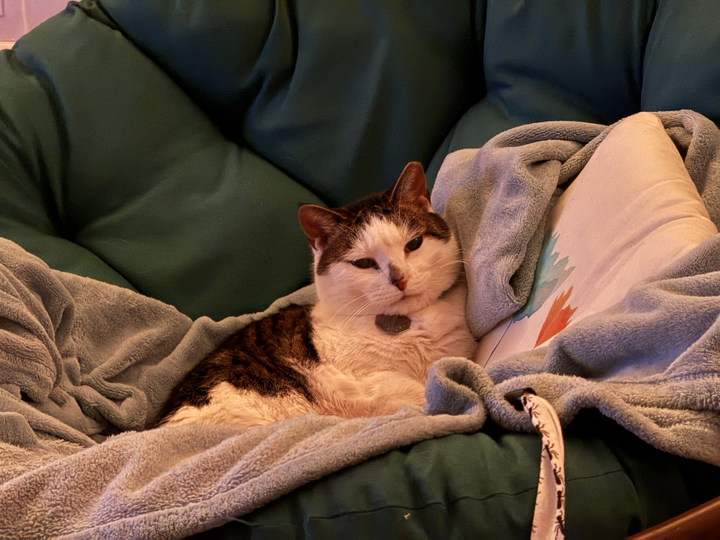
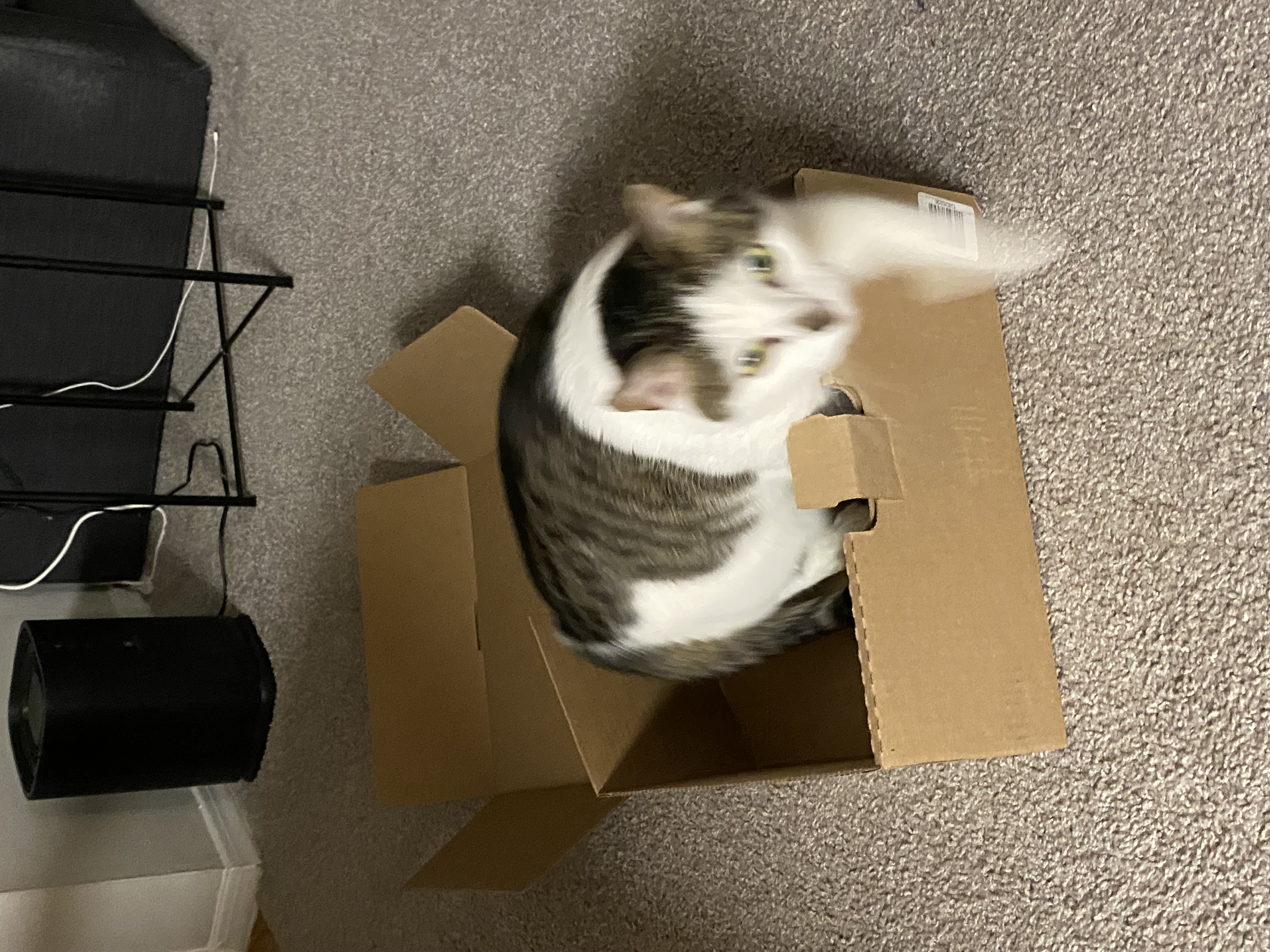
And now, your weekly Koko.
That’s all for now! See you next week with more sweet, sweet content.
In solidarity,
-Anna
Thank you for reading That Anna Marie Newsletter! This post is public so feel free to share it.