On the Tea hack, age verification laws, and killing the cops in our heads.
The Girlboss Panopticon
When the Astronomer CEO was caught cheating on his wife at a Coldplay concert early last month, the Internet erupted in laughter. Memes were made, sporting events held parodies, even brands got in on the action. I, however, wanted to log off and hide my face forever; yes, the guy should not have cheated, but I resented that incidents like this have to involve the public at large. Even more so, I resented the fact that this public mockery was being done in the name of Justice and Feminism.
This is not much of an escalation from the West Elm Caleb story from 2022, where a singular man had his identify blasted online for standing up a few women that he met via online dating apps (and allegedly sending unsolicited nudes, too). For weeks, one Bad Man’s bad actions were made the topic of much internet discourse about “love bombing” (as misunderstood then as it is today) and many companies participated in gross viral marketing that alluded to him. In Rayne Fisher-Quann’s insightful essay about the incident, she critiqued our new era of surveillance feminism…
the fact that hordes of women gleefully ate up tongue-in-cheek caleb-branded ad campaigns made it clear to me that any justifications of a high-minded feminist morale were purely aesthetic: either you admit that you’re cool with companies making money off of an abuse scandal, or you admit that the anti-caleb campaign was never really about abuse at all
As a prison abolitionist who believes in restorative justice and new forms of accountability, I can’t help but see West Elm Caleb, the astronomer CEO, and even the loose set of attitudes some call “cancel culture” as everyday citizens doing the state’s job for them. At my most cynical, it seems to me like everyone is surveilled by each other all the time in a virtual panopticon. We’re obsessed with the exploitative true crime genre, we have increasingly sterile social interactions as we turn to AI validation machines for companionship, we intellectualize individual people’s misguided actions on social media, and we turn everyday people into public figures against their will in the name of “justice”, though it’s really more for our entertainment. We say we want real justice, but we still LOVE the idea of The Bad Guys getting punished. We fail to challenge the root problem—the state’s monopoly on violence—and we’re surprised that women are still getting hurt. It’s bad enough that our doorbells, watches, and platforms through which we enact our relationships are cops, to say nothing of the exploding budget of violent agencies like ICE; do we really have to be each other’s cops, too?
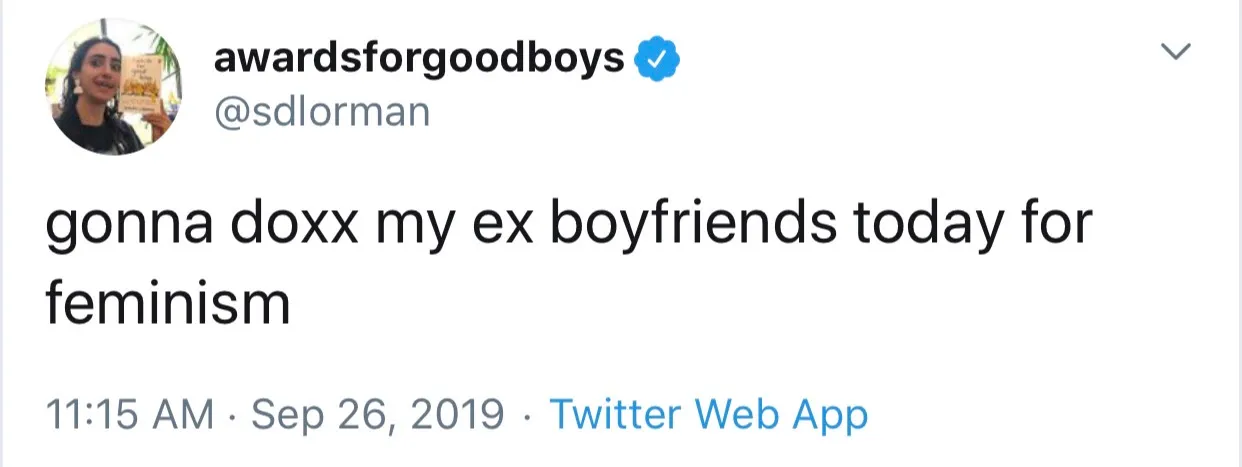
A tweet by Awards For Good Boys author Shelby Lorman (who also wrote a good essay on West Elm Caleb): “gonna doxx my ex boyfriends today for feminism”
This type of surveillance is having a deep effect on our IRL behavior, particularly as it pertains to gender relations. As I alluded to in my essay about Sabrina Carpenter’s album cover and the sex-negative backlash to it, for many zoomers and millennials, sex is associated more with threat than pleasure. Women are constantly on edge about how they’re being perceived, the “double consciousness” that women have always been privy to but magnified by a thousand by social media. Women deal with men making AI deep fakes of them and/or covertly filming sex acts to use as revenge porn. On a wider scale, people of all genders are on edge as any public slip-up might be captured on a stranger’s camera and turned into a meme. No wonder relations between men and women are so fraught! (As a college instructor, I can verify that Gen Z is terrified of being seen as “cringe”, which limits their ability to live authentically; there’s a quiet sadness to their generation that makes them difficult to reach on a personal level.)
Additionally, as Kate Wagner argues in her latest essay in Lux, our online culture of moralizing and intellectualizing our sexual desires is preventing us from real, pleasurable erotic experiences…
The fact is that our most intimate interactions with others are now governed by the expectation of surveillance and punishment from an online public. One can never be sure that this public or someone who could potentially expose us to it isn’t there, always secretly filming, posting, taking notes, ready to pounce the second one does something cringe or problematic (as defined by whom?). To claim that these matters are merely discursive in nature is to ignore the problem. Because love and sex are so intimate and vulnerable, the stakes of punishment are higher, and the fear of it penetrates deeper into the psyche and is harder to rationalize away than, say, fear of pushback from tweeting a divisive political opinion.
She goes on to write about #MeToo and the limits of storytelling-as-politics. Despite the conservative talking point that naming accusers “ruins lives” and circumvents due process, #MeToo was a net positive because it had the specific, tangible political goal of building solidarity to create structural change. Nowadays, callouts against cheating CEOs and other Bad Men are much more vaguer in purpose: perhaps if we publicly shame certain men, men as a whole might act differently? Another leftist push for collective actions gets co-opted into a liberal plea for changed individual actions.
Leaking The Tea
It’s in this low-trust environment of danger lurking around every corner where digital whisper networks form, which brings us to an app called Tea. If you’re not already familiar with “Are We Dating The Same Guy” groups on platforms like Facebook, these are private groups that mainly cater to women who are navigating the dating market. Users go to these online spaces to post pictures of and stories about the men they match with on dating apps, often spilling tea (sharing stories of the men in question) or requesting tea (posting pictures of the men in hopes of verifying their safety). The logic of these groups is, we can turn the surveillance onto men to take our power back.
As covered in depth by Amanda Hootman, these groups are simultaneously productive and messy. At best, they serve to (successfully) protect women, which definitely deserves praise. At worst, they foster a culture of extreme distrust in the opposite sex. This is to say nothing of the risk that one takes on by making accusations against men in a way that is ostensibly “private” but always vulnerable to leaks from bad actors, particularly when these groups operate at scale—an IRL whisper network might be focused on a single workspace, keeping things small and pragmatically focused on one Bad Man, whereas city-wide (even state-wide) whisper networks balloon these risks exponentially, as we’re learning from the attempted lawsuits against such groups by accused men.
Tea, an app founded in 2023 but which skyrocketed in popularity this summer, is this same concept but centralized onto one platform. Marketed as being “the safest place to spill tea” and “an app that's like Yelp, except for reviews of men”, the app required its users to submit a picture of their government photo IDs as verification to use the platform.
You might expect from that preamble that I’m against the idea of “Same Guy” groups or apps like Tea, but I’m not really. I just want us to be clear about both the benefits and the risks. After all, whisper networks are useful, maybe even essential, but they are not justice. As Sarah Jenny writes, they “arise in a vacuum of justice. They alleviate an untenable condition; they do not actually address it.” Whereas #MeToo featured public callouts that were directed squarely at systemic change, whisper networks exist by definition do not publicly call out anyone; their purpose is to protect as many women as possible without alerting the men in question, the media, the police, or any other body that could hold the men accountable. It is a strategy that is often unfortunately necessary in a society that doesn’t believe women and where less than one percent of rapists are ever convicted.
It makes sense that apps like Tea exist. Women have to protect each other. But it’s a band-aid on a gaping wound, and when whisper networks get centralized onto a globally accessible platform, the risks become too great. Posting pictures of Bad Men in private Facebook groups isn’t quite the same as doxxing, but posting the same pictures to Tea is more like doxxing than not, which is exactly what the ghouls over at 4chan took issue with.
In July 2025, shortly after Tea made it to #1 in the Apple App Store, the platform’s data was hacked and leaked by misogynists (a story which ostensibly demonstrates why the app needed to exist in the first place). Apparently, the data wasn’t very well protected to begin with, stored in an unencrypted, unsecured Firebase storage bucket, akin to a bank leaving the vault door open. As first reported by 404 Media, 72,000 images, including 13,000 women’s selfies and government photo IDs, were made public. In a subsequent breach, 1.1 million posts, comments, and chat logs were exposed as well.
“DRIVERS LICENSES AND FACE PICS! GET THE FUCK IN HERE BEFORE THEY SHUT IT DOWN!” boasts the 4chan user who spread Tea’s data breach.
Immediately, online losers whipped up databases of the leaked women (who they refer to with the incel terms “roasties” and “foids”, short for “femoid”). Some took it further, developing a searchable map of Tea users and even a website called “TeaSpill” where anyone can vote on Tea user’s leaked selfies Tinder-style to rank the women by attractiveness.
A map of Tea users using the breached data, overlayed with a 4chan comment reading “I made a map of the roasties, enjoy”. (KnowYourMeme)
The conservative men of the world will say that this situation is ironic: “these women joined an app to doxx men and ended up getting doxxed!” I think it’s ironic for a few other reasons. It’s ironic that the men complaining about the app’s existence are exactly the men women want to be protected from. It’s ironic that the women-attractiveness-rating site “TeaSpill” is exactly how Facebook, the site of many Same Guy groups, first started (as “Facemash”). It’s ironic that the app called itself trustworthy, and yet users were told that their photo IDs would be deleted after being used for verification (the platform creators were either lying or being extremely incompetent). And it’s especially ironic that thousands of women, in an effort to protect themselves, gave up their personal information to a platform without thinking twice.
In my view, the real lesson of the tea hack is that our culture has a lot to learn about privacy and surveillance. If our whisper networks were small yet distributed, rather than centralized onto a single platform, this sort of breach would have never been possible.
Epistemicide
I can think of one more irony: the UK and certain US states have enacted “age verification” laws which require you to show government ID to access certain parts of the web. Not only does this endanger every citizen of getting doxxed through a data breach, but this is a direct attack on free, accessible knowledge. Platforms from Discord to Reddit to Spotify are following suit, and YouTube has even announced a country-wide age verification step for the US. Using AI, no less! Sure, some people will just install a VPN, but a) most won’t and b) they shouldn’t have to. (It’s worth noting that the new UK law can easily be circumvented by actions as simple as borrowing your grandparents’ ID or as complex as using video games to make fake selfies, so the bill will likely not protect a single child. Only negatives, no positives. Yay, democracy!)
This gets even more upsetting as platforms crack down on “age-inappropriate content”, which often means any content relating to polyamory or being LGBTQ. Platforms like Steam and itch.io are doing exactly this, echoing the actions of Imgur and Tumblr before it. (The UK law is already barring people from accessing information about gender-affirming care and the genocide of Palestinians, because obviously.) Despite the guise of “protecting children”, bills like the Online Safety Act in the UK and KOSA or FOSTA/SESTA in the US were always about erasing queer history and harming sex workers, the latter of whom have been sounding the alarm about this for ages; it wasn’t that long ago that credit card companies were facing criticism for allowing people to pay for OnlyFans content. Sex workers and trans people (especially when they overlap) are always the canaries in the coalmine for authoritarianism.
A meme shared by sex workers for many years. A riff on the “myth of consent” meme where two people say “I want to draw it” (presumably explicit art) and “I want to see it” but Mastercard and Visa say “I don’t!”
The internet as we know it is changing. There are no safe spaces left for anyone of any age group. It’s very possible that most platforms will soon require users to verify their age with a photo ID, leaving hundreds of millions of people vulnerable to data breaches and further surveillance from the government. (I know for certain that if a platform requires me to verify my age, I will simply leave that platform, assuming I can’t get around it somehow. I don’t care how essential the tool is to my daily life; I will figure it out.)
Worse, now that we’re living in an authoritarian nightmare, it’s not impossible that there could be a full-on internet shutdown. Suppose there were a sustained leftist protest movement who used to internet to organize; do you believe that the Trump administration would simply continue allowing the general population to have the Internet? Even without a specific inciting incident, how much longer will the ruling class put up with constant mockery and fact-checking online?
With so much of how we enact our relationships being based online, including the ways we protect ourselves using apps like Tea, I can’t help but wonder what would happen if the Internet ever went away. I’m aware of how much this makes me sound like a prepper, but I think it’s worth it for everyone to consider it as a hypothetical at the very least. How will you access food, information, and community in a shutdown scenario? How will you live when no platform is safe?
So, what is this, another call to “log off”? No, but we should be prepared for the worst. Get back into the streets, into community, GO TO YOUR LOCAL LIBRARY, and Never Trust A Platform. (I need that last one on a t-shirt). Maybe if we could learn to center local, offline, embodied knowledge, we wouldn’t be so vulnerable.
I also don’t want to freak you out; doomsday has not come. It may never come. The Internet is not ending, it’s just changing. We can still build digital spaces for ourselves, they’ll just have to be underground: the indie web, blogs, off-grid messaging like Meshtastic, and tools we haven’t even dreamed of yet. Putting all our communication into a single-digit number of platforms made by tech bros was a mistake; the future is a constellation of tools made by us and for us. Much like how one 10,000 protest can be stopped by police but ten 1,000 protests spread across a city can’t, we are more powerful when we’re together yet decentralized. I can’t wait to see what we make.
A timeless meme of a dog sitting in a half-sunken lawn chair. “it’s going to be okay, but it’s going to be different”.