The NHS Study on Trans Youth Was Heavily Biased
On the Cass Review and anti-trans science.
Real quick up top: you can now register for my summer course on plastics! In this 4-credit Gen Ed course, I’ll teach you all about plastic pollution: how we got here, and what comes next. Read more here and consider joining the class, whether you’re a Five College student or an industry professional. Here are TikTok and Instagram videos about it if you want to learn more. Thanks!
Note: This post is loosely based off a video I recently made. If you’d prefer to watch/listen to this post, that’s one way to do it!
Surprise! The study going against scientific consensus on treating trans youth was heavily biased and written in collaboration with anti-trans lawmakers.
The Cass Review was a report commissioned by the NHS of England to figure out if gender-affirming care is appropriate for minors. The review ended up coming down negatively on gender-affirming care, and they seemingly did this by cherry picking studies that support their prescriptive conclusions about the ethics of allowing kids to transition. The Review is already being used as a justification for rejecting transition care for minors in the UK, which goes against the guidelines of many national and international bodies that are in support of transition care for minors.
A lot of trans people had this hunch that the Cass Review must have been unscientific and biased, but hasn’t been a rigorous deconstruction of the Cass Review. Until now.
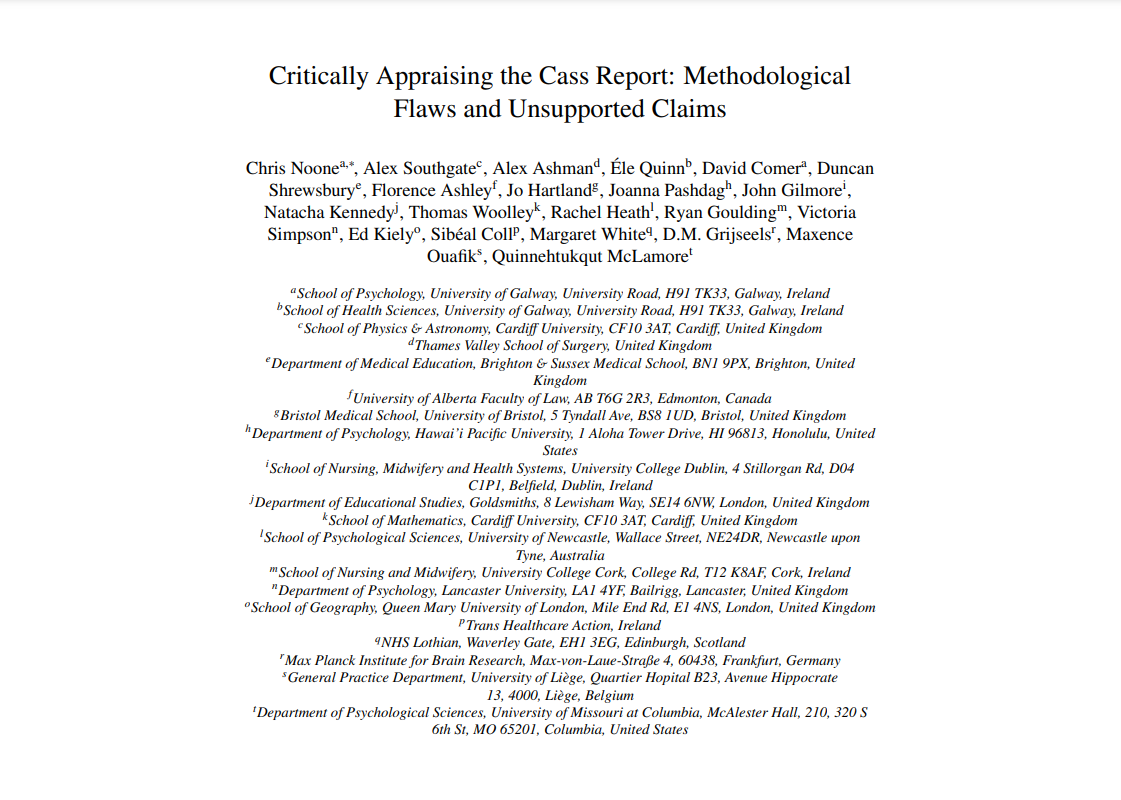
This past week, a group of 21 interdisciplinary researchers from 20 institutions who study trans health care published their critique of the Cass Review, which is now available online as a preprint. While it’s still a preprint, meaning that it hasn’t gone through the full peer review process yet, the critique clearly shows that the Cass Review was incredibly shady in both its design and its conclusions.
Allow me to put my “Science Educator Hat” on and explain this whole situation! If you’re not aware, a “meta-analysis” (sometimes called a “systematic review”) is a type of scientific paper that summarizes the results of many other scientific papers. For example, if ONE paper finds that the globe isn’t warming, but 99 papers say that it is, a “meta-analysis” would look at the results and methodologies of all 100 studies and come to the conclusion that, yeah, the globe is definitely warming! And that the one paper that says otherwise might have some limitations to it.
Side note: if you’re ever trying to answer a scientific question, try going to Google Scholar and searching “[your question] meta-analysis” or “systematic review”!
I’ve actually written a review paper myself; it’s my most cited research publication (at 1300 citations, wow!!) because it’s easier for people to reference one big paper that covers a lot of ground than to cite a hundred smaller studies. Naturally, the quality of a systematic review is entirely dependent on what papers it chooses to include. A good review needs to have a reasonable eligibility criteria that lets enough papers in to make the review actually relevant, while not excluding so many that it becomes biased. So, if a systematic review comes out that somehow finds a way to exclude 97 of those papers that say climate change is real, due to some nonsense criteria about effect size or something, that review is left with 3 papers, 1 of which says that climate change isn’t real. Which means now they’d get to say, “hey, 33% of scientists don’t believe in climate change at all! Clearly there isn’t enough scientific consensus on the matter for us to take action, we need more data!”
To avoid cases like these, it’s standard practice to follow pre-set rules like the PRISMA guidelines, which include ways to show readers exactly what the criteria are for having studies be part of the review. Using figures like these help show how many papers were initially identified as being relevant to your topic, why they were screened out, and how many papers ended up being looked at in the review.
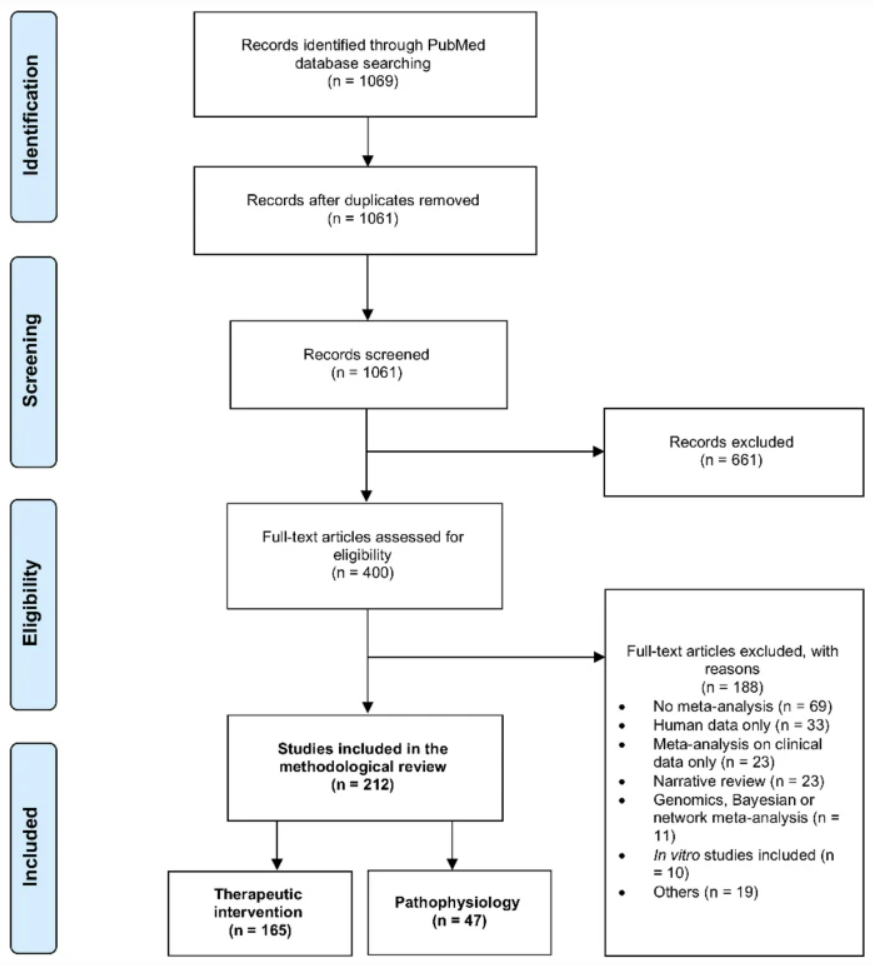
The Cass Review looked at seven systematic reviews and even did some of their own original research, making it SEEM pretty thorough. But as the critique points out, the Cass Review was incredibly ambiguous as to how these 7 studies were chosen, a lack of transparency that’s unusual for reviews like these and goes against PRISMA guidelines.
You can easily use my trick from before and find dozens of papers showing that gender affirming care overall improves trans people’s quality of life. But these papers are suspiciously absent from the Cass Review! For example, the preprint finds that the Cass Review excluded 48% of studies for puberty blockers, and 36% of studies on hormone therapy, making it almost as bad as that made-up, hyper-exaggerated climate change example I gave before. Translation: they extensively prove that the Cass Review was cherry-picking.
The Cass Review even comes to false conclusions about the already-heavily-based papers it’s trying to cite. To quote the critique directly….
…in the review on hormone replacement therapy, the authors argue that no conclusions can be drawn regarding any relationships between HRT and psychological health. However, this minimizes their own data. One study showed an improvement in gender dysphoria, one showed an improvement in body satisfaction, four studies showed an improvement in depression-related outcomes, three studies showed an improvement in anxiety-related outcomes, and three studies showed a decrease in suicidality/self-harm related outcomes. (Noone, et al.)
The critique goes into other issues too, like the fact that the Cass Review holds up randomized controlled trials as the “gold standard” for scientific studies. This might be the standards in other fields might be the case, but this ignores the fact that these are exceptionally rare—and even inappropriate—for studying hormone replacement therapy. First of all, there are the questionable ethics involved in giving cis people hormones they don’t want and NOT giving trans people the hormones that they need. And of course, it’s nigh impossible for participants to stay double-blind in a study where they start growing beard hair, breast tissue, or other effects of consuming opposite-sex hormones!
You can read the full preprint for more details, but basically, the Cass Review didn’t show their work, and got the wrong answer anyway. D-minus!
Obviously, that’s not stopping groups like the Alliance Defending Freedom from using it as further justification for their anti-trans laws. Previous authors have also found that Dr. Hillary Cass and other authors of the Cass Review worked closely with the Society for Evidence-Based Gender Medicine, the transphobic group who helped orchestrate the hundreds of anti-trans bills we’re seeing now. Scientific publications like the Cass Review give anti-trans laws an air of legitimacy, which is why I’m glad that other scientists are stepping up to call it out.
Let this be a lesson in scientific literacy; just because one paper says something that confirms your biases, that doesn’t mean it’s true. Looking at meta-analyses, even multiple meta-analyses, can present a much better picture. And even then, the methodologies can be questionable, so we should always stay skeptical.
Finally, you don’t need a PhD to simply believe trans people when they tell you who they are and what their needs are. You could just listen to the dozens of medical organizations who already support gender-affirming care. In fact, just today as I’m writing this, yet another international organization—The Royal Australian and New Zealand College of Psychiatrists—rejected the Cass Review’s conclusions. If every trans person and every cisgender expert says one thing, and every cisgender non-expert you meet says another, perhaps it’s worth listening to the former.
Happy Pride Month!
Currently Reading
- Two revelatory readings on the UMass Divestment movement were released this week. One came from some amazing student journalists who revealed that not only does UMass have deep investment ties to Israeli companies, but that the university never divested its endowment from fossil fuel companies, which they pledged to do after a different series of protests back in 2016. Another came from an insider on the Board of Trustees, who University Chancellor Reyes promised were going to discuss divestment during a June 7th BoT meeting, but never did. Despicable behavior!!
- Living legend Julia Serano reflects on the past 10 years of the trans liberation movement.
- Lynn Conway, the iconic trans woman responsible for the device you’re reading this on, passed away this week. Rest In Power, trans STEM icon!
- Perhaps the subject of a future post: apparently, AMAB people who remove their testicles tend to live longer by several years. Great news for the dolls who’ve got their orchi!
Watch History
- Proof positive that Windows Recall, which will soon be standard in Windows 11 PCs, will make your computer activity easily visible by hackers. DO NOT update your computer, folks!!
- A video essay about video essays, and why you shouldn’t believe everything your favorite creator has to say. (Including me!!!)
- A deep dive into the capitalistic forces destroying the animation industry, and how you can help.
- An overview of pro-natalist talking points. It’s interesting to see how some conspiracy-heads will say that overpopulation is the problem, while others say it’s underpopulation. (Either way, it’s an excuse to be racist, so I suppose it doesn’t even matter which version you pick!)
- For Men’s Mental Health Month, a satirical deconstruction of a leading voice in ruining male mental health.
Bops, Vibes, & Jams
- L'Impératrice is a pop-funk band out of France I’ve been keeping my eye on for a while. In their new album “Pulsar”, they have outdone themselves, with some amazing collab songs like “Danza Marilù (feat. Fabiana Martone)”, “Any Way (feat. Maggie Rogers)”, and “Sweet & Sublime (feat Erick the Architect)”.
- Charli XCX has released her new album, “BRAT”. Favorite tracks: “360”, “Von dutch”, and “B2b”.
And now, your weekly Koko.

That’s all for now! See you next week with more sweet, sweet content.
In solidarity,
-Anna
Thank you for reading That Anna Marie Newsletter. This post is public so feel free to share it.