Something Is Wrong At The EPA
On jet fuel, burning plastic, and environmental injustice.
Real quick up top: you can now sign up for my summer course on plastics! This course is worth actual college credit and will teach you everything you need to know about how plastics are made, what makes them unrecyclable, and what we can do about it. You don’t even need to be a current Five College student to take it! Learn more about how to enroll here and check out the course syllabus on my website. Thanks!
The Environmental Protection Agency has their hands full, and it’s all plastic’s fault.
From the infamous vinyl chloride monomer (VCM) spill in East Palestine, OH to the lesser-known nursery fire in Florida which set plastic pots up in smoke, American news has been awash with apocalyptic imagery of tall flames and black smoke. It’s hard for the average person to comprehend why pillars of smoke keep appearing in their news feeds, but let me cut through the noise: all of these incidents are happening because of our reliance on oil and gas.
Most of the conversation around plastic has to do with its end-of-life treatment: how much goes to recycling, how much goes to landfill, how much ends up in our oceans, or how much ends up as microplastics. But we must not forget that plastic is made from fossil fuels, most often from the fracking and cracking of crude oil into ethylene, which can then by polymerized into polyethylene (HDPE or LDPE) or chemically modified into other monomers like vinyl chloride (the toxic chemical involved in East Palestine which forms PVC). Nearly all of the high-profile chemical disasters of 2023 so far are tracible back to fossil fuels, and what’s most haunting is that chemical companies keep getting away with it while everyday people are paying the price.
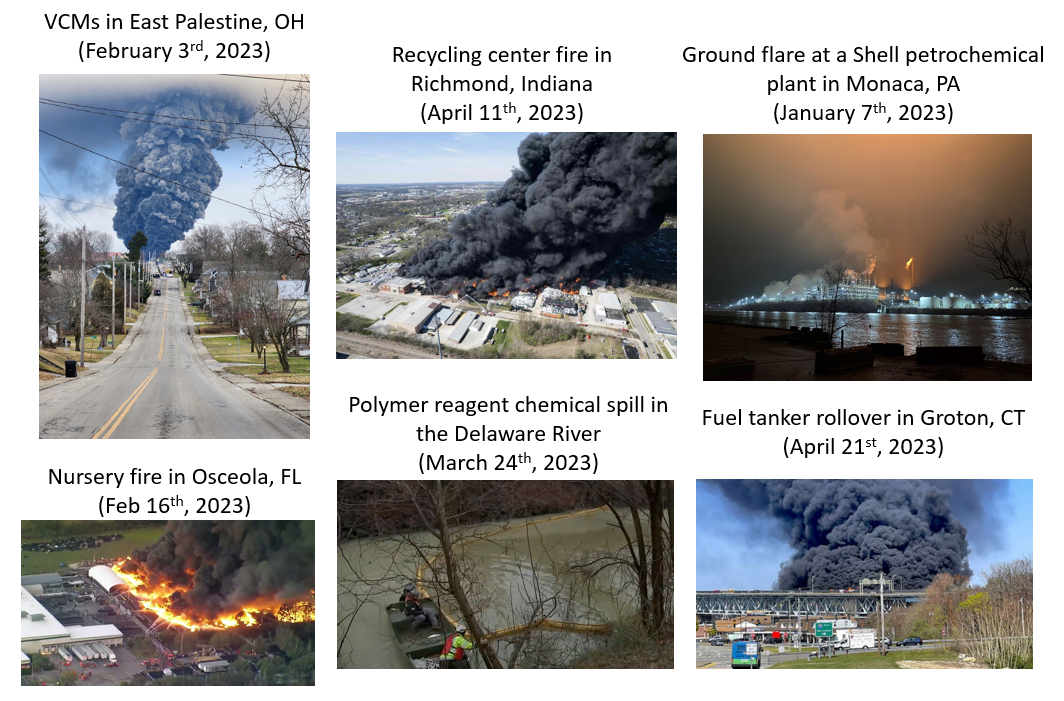
But even though it hasn’t yet resulted in a visual spectacle like these disasters above, one plastic-related issue rises above the rest: a new form of jet fuel that will cause 1 in 4 people to get cancer, recently approved for production by the EPA.
Yes, you read that right. The EPA just put their seal of approval on a process developed by Chevron to turn plastic waste into jet fuel, and its production process is deadly. Let me explain.
Plastic recycling is notoriously complicated (take my summer course to learn more about that!) but it can be broken down into four main types. Primary recycling is what most people probably think of: shredding up a plastic bottle, melting it down, and turning it into another plastic bottle. Secondary recycling is actually far more common, which involves turning plastic into a lower-value product or something that is more difficult to recycle, such as PET from bottles being made into polyester fibers for clothing. Quaternary recycling is simple: burning plastic for energy. Because plastic is derived from fossil fuels, we can extract some energy from them, in fact over 16% of the energy the U.S. gets from burning waste comes from burning plastic. Naturally, this non-regulated open burning emits an obscene amount of toxic and cancer-causing gases into the atmosphere.
Then comes tertiary recycling, otherwise known as chemical recycling. This has been the subject of lots of scientific investigation, since we have a lot of plastic waste to deal with and the above methods don’t really work that well. The goal of chemical recycling is to deconstruct polymers into usable chemicals for new, value-added applications. For example, if we could disassemble polyethylene back into ethylene, we could use it to make new polyethylene or use it in other ways, like to make ethanol fuel. Unfortunately, polymers are notoriously hard to break down—that’s why we use them, because they last for so long without degrading in quality. So, researchers have had to get creative in how they chemically modify plastic waste.
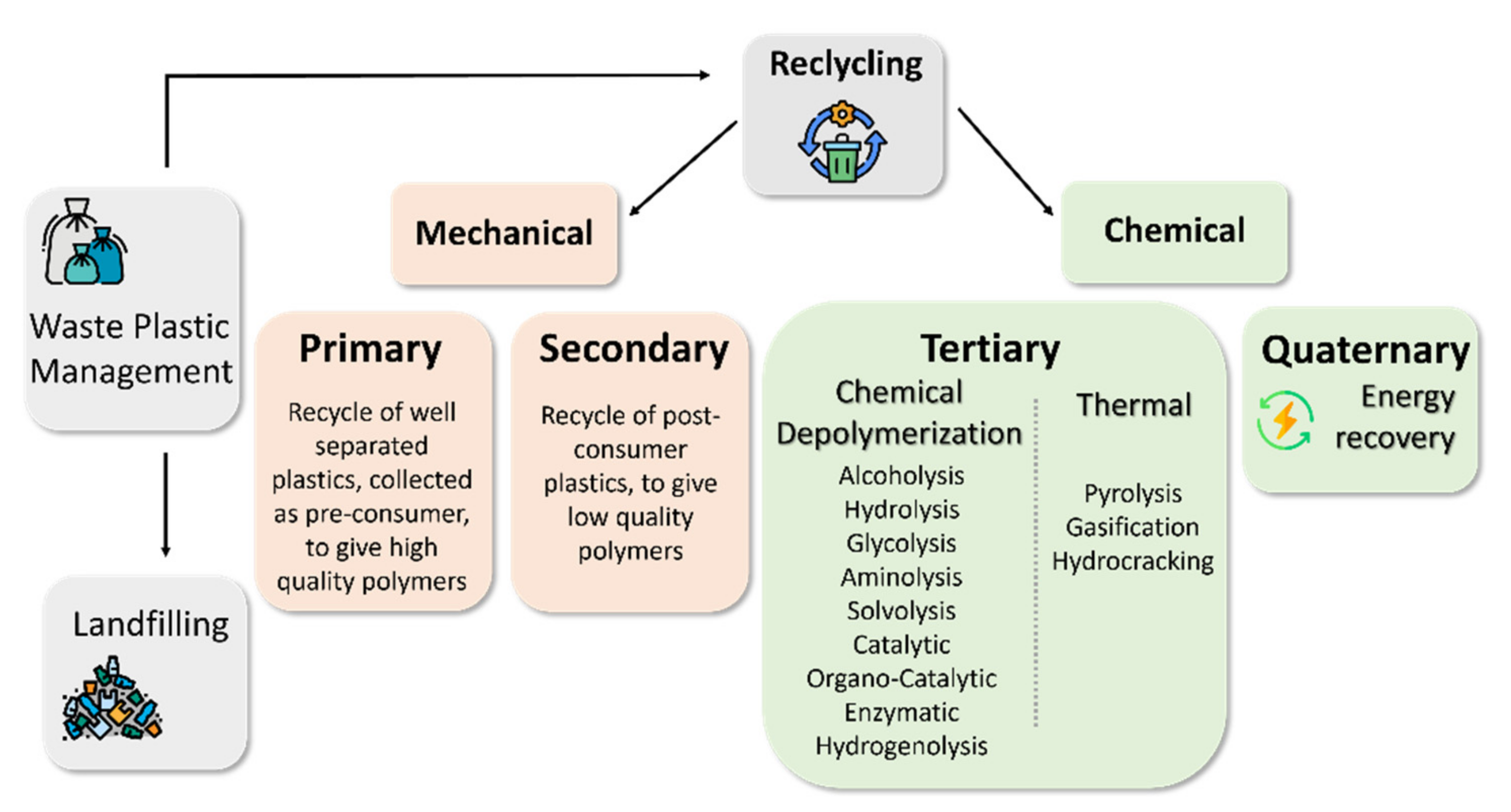
One option for treating plastic waste is called pyrolysis. This involves burning plastic to form gaseous products (such as carbon dioxide and other greenhouse gases), solid char, and a low-molecular-weight oily substance, the latter of which can hopefully be extracted as a fuel source. If this sounds a whole lot like “burning plastic”, you’d be right; while this process takes place in a semi-controlled chemical refinery-type environment, as opposed to quaternary recycling which is often just open burning, both involve heating plastic waste to extremely high temperatures until it chemically degrades.
Some have proposed that pyrolysis products can be used to make new polymers rather than making “virgin plastic” out of fossil fuels. But this isn’t such a good idea. A 2023 study showed that the environmental costs of plastic pyrolysis were 10-100x that of making virgin plastic due to the insane amount of emissions associated with the process. This is a no-go, but nonetheless, most research in the treatment of plastic waste has been devoted to pyrolysis.
Which brings us to the EPA.
Chevron is an oil and gas giant, one of the companies largely responsible for the climate change crisis that is already affecting our world. Recently, in an effort to greenwash themselves, Chevron’s oil refinery in Pascagoula, Mississippi started production on a new type of jet fuel made from plastic waste. To the uninformed reader, this seems like good news: finally, a solution to plastic pollution that we can get something out of!
Not so fast. According to documents from the EPA, this new process (a form of pyrolysis) would produce air pollution so toxic that 1 out of 4 people exposed to it over a lifetime would get cancer. Additionally, the air pollution produced when the fuel was burned would cause 7.1 cancers in every 1,000 workers.
And for some reason, the EPA approved its production.
For perspective, the EPA usually never allows chemicals to be made when they are shown to have a cancer risk of 1 case per 1 million people. (This is known as the assimilative capacity model of pollution: if the cancer rate was 0.0000012 for example, that chemical would get banned, but since it’s only 0.0000010, it’s passable. A critique for another day.) This fuel has a cancer risk of 1 case per 4 people, which is 250,000 times the normal limit posed by the EPA. The cancer risk of smoking cigarettes regularly is actually lower than this.
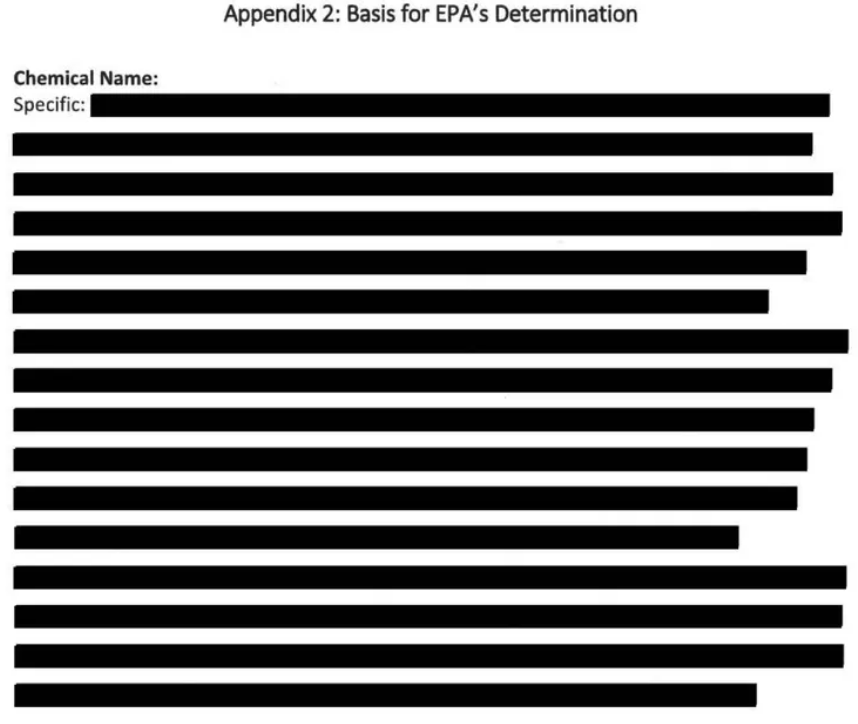
So why did the EPA approve the making of this fuel? We just don’t know. The ProPublica article that broke the news proposes one answer: a Biden-Harris executive order to speed up the approval process for new, non-fossil-fuel-based energy alternatives. This is plausible, if silly: plastic is fossil-fuel based, after all, and pyrolysis is anything but climate-friendly. Even shadier is the EPA documentation that’s supposed to explain the decision-making process for the approval, which is redacted in all the most critical parts, including the chemical composition of the jet fuel.
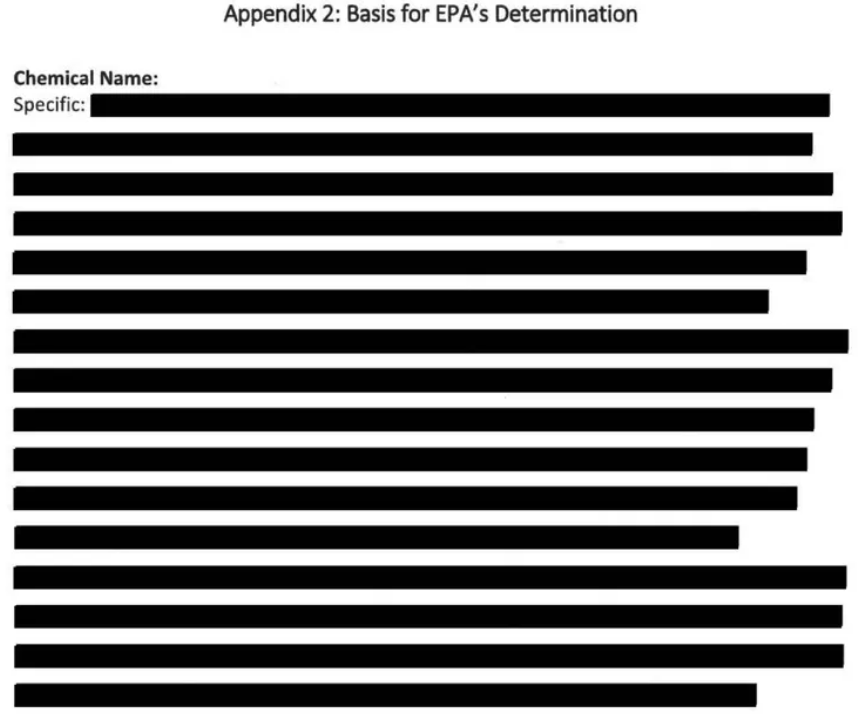
This complete lack of transparency is incredibly strange for the EPA. I can’t say for certain, but given how much Chevron has lobbied the government and would have a vested interest in such a greenwashing project, it’s not hard to come up with conspiracies. I’ll stress that we don’t know anything for certain.
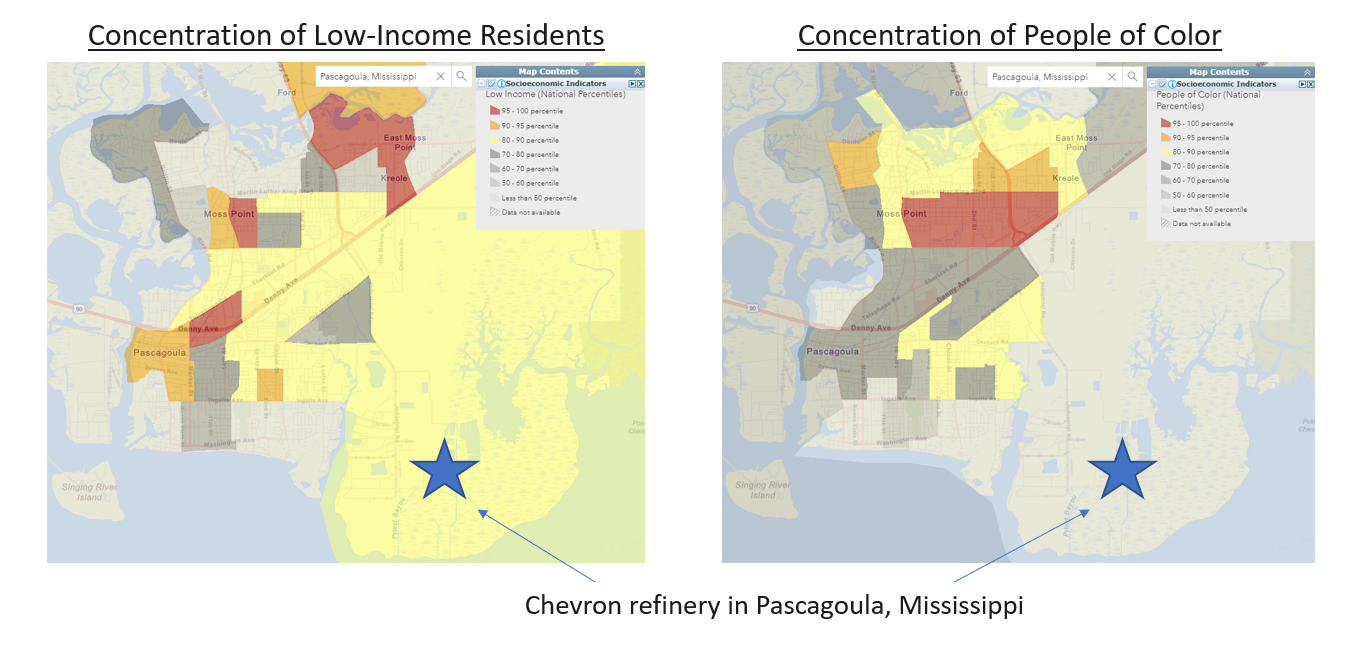
It’s worth stressing that this is an environmental justice issue as well. The Pascagoula refinery sits directly next to several communities of color and low-income residents, which ironically, I was able to find out using the EPA’s EJScreen website. The neighborhood was already a cancer hotspot, with a cancer risk 3.4 times what the EPA considers acceptable. Recently, as the company has been testing the pilot plant and winding up operation, the local community has started reporting strange odors and air so potent that their kids can’t play outside anymore. Chevron apparently ran their own tests and claimed that the air was fine, but this stands against the claims from hundreds of citizens about their own air quality.
Luckily, the local community is fighting back against Chevron and the EPA. Cherokee Concerned Citizens, a local community group that formed in the area in 2013, has just filed a lawsuit against the EPA for approving this new chemical. With representation from EarthJustice, the lawsuit alleges that the EPA did not follow the chemical approval process laid out in the Toxic Substances Control Act. This Gizmodo article appropriately points out that Chevron’s Pascagoula plant has failed to comply with emissions limits and safety regulations in the past, and that this pyrolysis product does not constitute “biofuel” as Chevron claims.
Personally, I hope the community wins. It may initially seem odd that the EPA is getting attacked from both the Left and the Right nowadays, but I will always be on the side of the people, on the side of safety, and on the side of workers.
This whole situation calls to attention an alarming trend in our modern politics. Remember how Chevron ran their own tests and claimed that the air was fine? It’s actually not uncommon for companies—and even the U.S. government—to rely on private firms to do their own environmental risk-modeling. As an environmentalist and an activist, this worries me. Private firms have far less accountability to the public than government agencies do, and thus will always have a vested interest in massaging their data (or outright lying) to make their clients seem greener than they are. Never mind the fact that climate change is notoriously difficult to model or predict, which makes the whole issue even more slippery: how many companies will outsource their environmental risk assessments to a private firm, and then when disaster inevitably strikes, how many will simply blame the model and not their behavior?
I wish I had a satisfying conclusion to this post. I guess all I can say is, do your part to divest from plastic. This will be easier said than done; more local to me in Northampton Massachusetts, a Coca-Cola bottling plant is closing down this summer. This is good news for the fight against plastic waste, but also, that Coke plant paid for about 25% of the city’s water and sewer enterprise funds. This means that for the average Noho resident, their water and sewer bills are about to increase. Our country is so deeply entangled in fossil fuels and plastics that severing that bond will always be a challenge.
And yet, we must try. We must keep fighting corporations, and sometimes the government, for our right to clean air, clean water, and clean Land.
Keep watching what’s happening in Pascagoula. And just in case you needed the reminder…
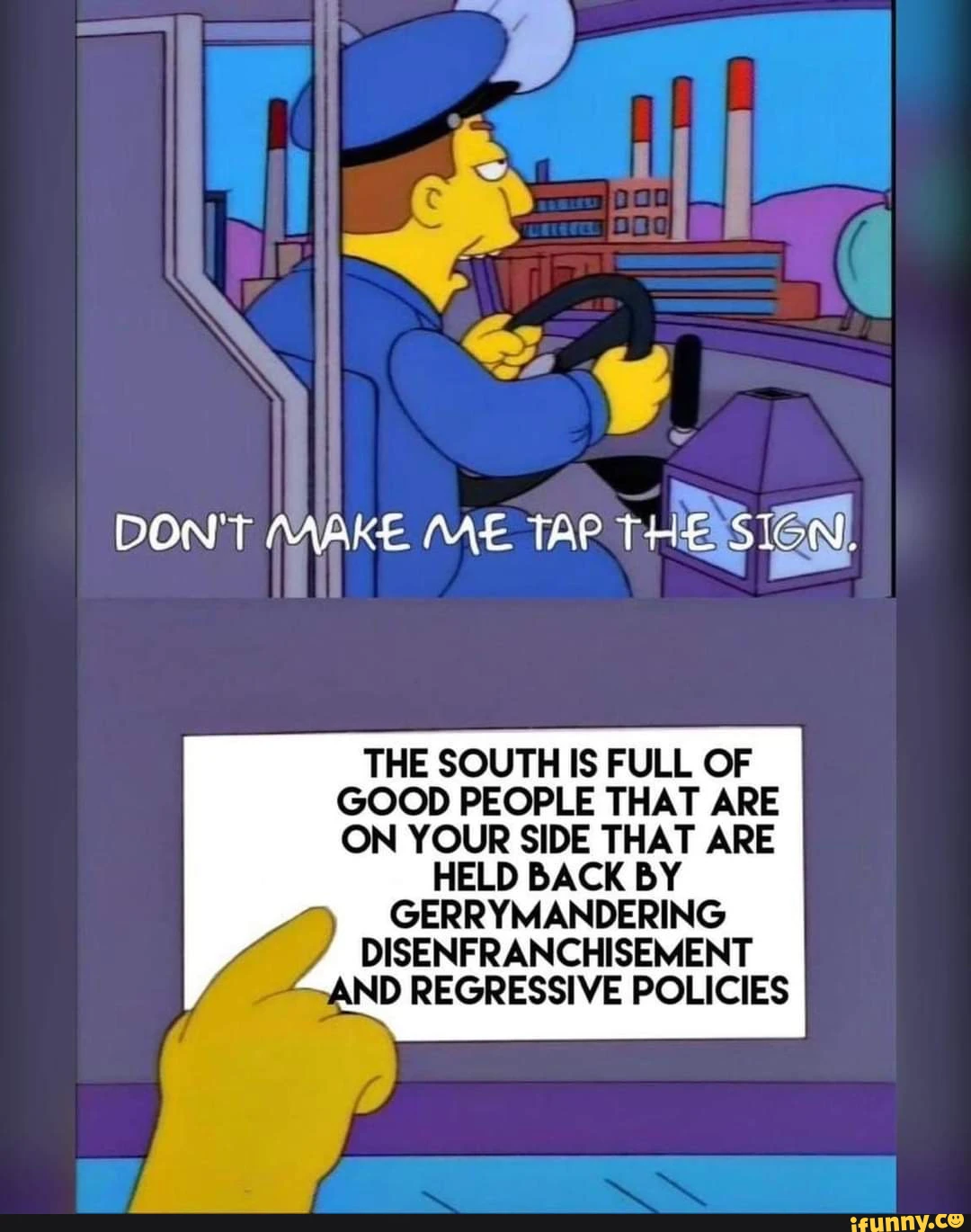
Quick Action Items
- Share: I have a friend in New Hampshire who is seeking legal help. They are a disabled trans person who is being pushed out of academia and needs representation. If you are, or know of, a lawyer who can operate in New Hampshire, PLEASE let me know so I can send their info to my friend! Even if you don’t know anyone, Share and engage with (comment, like, save, etc.) my Instagram post, Tweet, or TikTok video about the subject.
- Act: An easily-sharable Stop Cop City solidarity toolkit: bit.ly/MonthOfSolidarity
- Sign: A Pledge to Protect Black People and Trans People. (Related: #BlackTransLivesMatter Actions & Resources, plus a donation link. This is always in my “link in bio” on my website!)
Currently Reading
- A thread about the anniversary of Backpage dot com’s shut down and the history of sex work.
- A great piece that summarizes why I refuse to use Substack notes (in lieu of Twitter’s terribleness).
- My friend Kristi’s recent piece in her own Substack, “Half Hours on Earth”.
- The funniest thing I’ve heard all week and, honestly, an excellent meta-commentary on modern art. What does it mean that an artist can get paid $120,000 for a banana while others can’t afford to eat? The Right is right, maybe postmodernism does suck.
- Meta is backpedaling hard on the Metaverse, their awful vision of which I wrote about a few weeks ago.
- On being childfree in a time of fascism and climate change. Related: one of my favorite TikToks.
- Wholesome: American Football buys The American Football House.
Watch History
- I’m back on TikTok! Watch this short video about WaterTok and this longer video about what I learned over my month-long social media break.
- An actually-interesting video about the history of clip art.
- Sarah Z’s video about Replika, which yields a similar critique of AI as my many pieces of media about our relationships with algorithms (1, 2, 3).
- A transphobic mother saying that she’d rather have her child die than be trans. If you’re a parent, you should run FAR away from conservative ideology.
- Kimberly Nicole Foster’s classic video “Beauty is a bad investment”, which recently inspired a new line of art!
Bops, Vibes, & Jams
- A new Emily King album dropped this week!
- Chromeo is back with a new album cycle, and their new single features La Roux! (For a throwback, Bulletproof and In For The Kill are timeless bops.)
- Not sure how I missed the new Tank And The Bangas album last year, but better late than never! Here’s a new remix that’s great too!
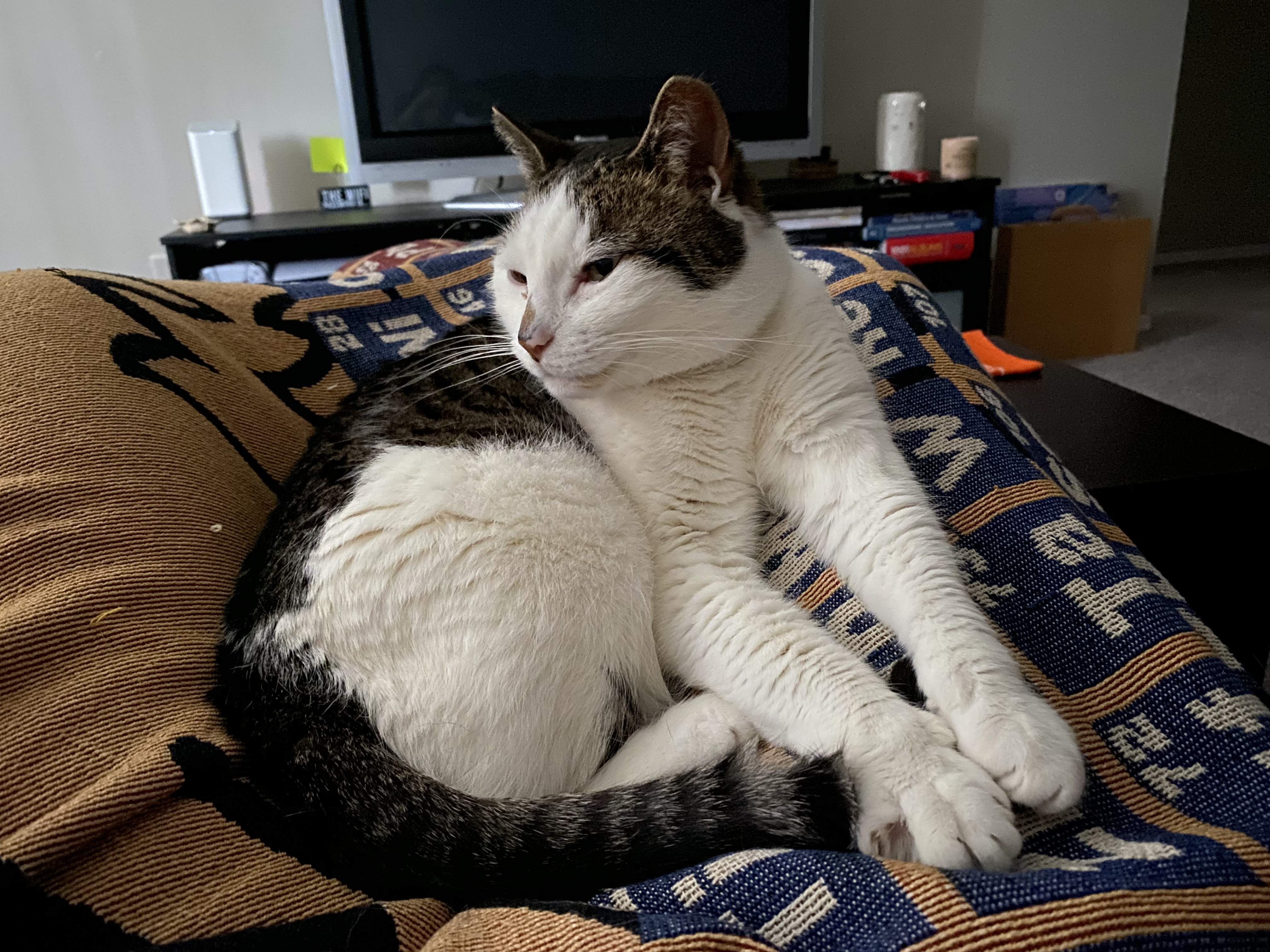
And now, your weekly Koko.
Amazing news: Koko has finally become a lap cat! Last Friday she voluntarily climbed up on my lap and started cuddling!!! My life is truly complete.

That’s all for now! See you next week with more sweet, sweet content.
In solidarity,
-Anna
Thank you for reading That Anna Marie Newsletter. The best way to support my work is to share it with your network! also, consider becoming a paid subscriber for a look into my inner world.