Refining Trans Terminology
On "elder", "transsexual", and other difficult words.
Earlier this year, while I was still using Bluesky to some degree of regularity, I came across an acronym I hadn’t heard before, but which apparently pertained to me. “TMA”, as it was used in this smaller pocket of the trans internet, stood for “transmisogyny affected”, as in “an individual who is affected by transmisogyny”. Oh, boy.
Certainly, transmisogyny (trans misogyny, if you prefer) is a thing. There are people in the world who are “affected” by the phenomenon of transmisogyny (namely trans women and other transfeminine people) and those who are not (namely gender-conforming cis men). However, to this day I question if this “TMA” term should even exist; are not all women affected by transmisogyny in some way (cis women are punished or even accused of being trans for being “clocky”, gender non-conforming, etc.)? Are not all humans punished for transgressing gender norms, in either “direction” (men who are feminine are punished for being more-woman, less-man, or transfemme-like, depending on how you look at it)? The more you think about it, the more the boundaries between who is “transmisogyny affected” and “transmisogyny exempt” (another proposed term) start to become muddled. Besides, we don’t have “racism affected individual” as its own term, we just say “person of color” or describe an incident/system as racist. At best, definitions of “transmisogyny affected” and “misogyny affected” are concentric circles; at worst, they are perfectly overlapping circles of the same size. Others, such as trans historian Jules Gill-Peterson who recently wrote a book titled A Short History of Trans Misogyny, seem to agree.
Making this critique on a platform like Bluesky, of course, would have resulted in me being dogpiled by those taking the least charitable interpretation of what I’m saying (I’m “erasing trans women’s experiences” despite being one, etc. etc.) and all manner of other toxic phenomena seemingly exclusive to platforms which incentivize performing the Correct Opinion for an audience (your loyal followers, onlookers who you wish to make your audience). But I’m getting ahead of myself.
Do we really need more language to describe the trans experience? Could we possibly even stand to have less terminology? There’s this urge online to rigidly define the parameters around identity groups; trans men vs lesbians, trans women vs gay men, “binary trans” vs non-binary trans, and so on. I would argue that this urge to split and sort stems from a white, colonial mindset that only respects quantitative, part-to-whole, binary thinking rather than holistic trust for the daily lived experiences of others—the equivalent of taking cells out of the environment to study them in a sterile lab versus studying the same cells in their natural habitat and observing the emergent relationships. (Translation: girls can be gay guys, too.)
This is just one of the ways that trans discussions are being limited. This post is my attempt to refine some existing trans terms, and even to define new ones. I’m presuming readers have familiarity with trans terminology and the distinctions (again, where/if they even exist) between trans, non-binary, genderqueer, gender non-conforming, and more. I could also be totally off base with any of these, as in I may not agree with these even a month from now, but I encourage you to (respectfully) let me know in the comments where I may be missing the mark. I’ll also concede that debating the meaning of words may not be the best use of our time right now; there are ICE agents actively storming the streets and trans people dying every day from suicide or lack of material support. I’m not an anthropologist, I’m an engineer; I write with the pragmatic urgency of someone whose livelihood is being directly threatened. My goal is to unite the trans community and our allies towards positive movement-building, not to threaten or demean anyone.
One’s Trans Age/Era
Every time someone in their 20s describes themselves as a “trans elder” it makes me want to denounce the entire trans community and become a Republican. Elderdom is not a mere function of “how long you have been out”, and even if it were, 10 years would not be the threshold. Maybe not even 20 or 30 years.
When I think of a trans elder, at least in the current year, I think of someone I know who carried a switchblade on them through Times Square while they did sex work in the 80s. I think of someone I know who self-castrated in the 70s, went back into the closet, and retransitioned in the early 2000s. I think of someone I know who lost every single one of their friends to AIDS. I think of those with grey hair, wrinkles, and killer dessert recipes.
More than just “an old person who is trans”, I think of elderdom as a specific community role that you attain through service. In other words, if you’ve lived your whole life as an albeit-a-bit-repressed cishet man until age 65, and are now 68, you might be an elderly person but not a “trans elder”. Elderdom implies a lifetime of helping others, particularly “raising” those of the generation after you; helping them access resources, hormones, or housing, supporting the newly-out when no one else would. We already colloquially use the term “baby trans” (those who started their transition mere weeks or months ago), so if we’re to invoke familial roles, perhaps we can distinguish between babies, teenagers, young adults, mothers, and grandmothers/elders.
I, for example, am role-wise a mother—I have mentored/mothered several trans people “younger” than me but have not done so for long enough that I’d like to claim “elder”—and age-wise somewhere between a “teenager” and “young adult”—I started my transition 8 years ago. You heard it here first: I’m a teen mom. I can foresee some of the aforementioned younger trans folks claim to be a grandmother/elder because trans people they have mentored have gone on to mentor other trans people, so maybe this idea needs refinement.
Along with how long you’ve been out, it may also be worth having terminology for what era of politics you transitioned during. I outline several reasons why this could be important in a prior essay, and this paragraph is of course localized to the American context. I, for example, am a white Trump 1.0 transitioner (2017-2020), able to reap the rewards of the post-Tipping point era of optimism and getting paid to give diversity seminars at universities yet grounded by living through a Republican administration that was winding up its attacks on trans people. People who transitioned just a little later than me (2020-2021 COVID Lockdown-era transitioners) may think/behave totally differently than me, as would people who transitioned just earlier than me (the 2010-2014 pre-Tipping Point transitioners who likely were the first to challenge their schools and workplaces on trans inclusion and win).
Literally Anything About Detransition
Here, I’ll simply point to the amazing work of Kinnon R. MacKinnon and Pablo Expósito-Campos. They’re currently posting a series of essays related to their recent DARE Study, a groundbreaking work about detransition. In Anatomy of a terminological chaos, they outline the challenge of having too many terms…
Imagine you started a gender transition in 2009. After years of questioning, you decide to stop. You feel a pull to present in a way that aligns more with your childhood—a possibility you’d never considered before. You don’t know anyone who has done this; you’re not even sure if it has a name.
You search online for “stopping hormones transgender,” but what you find only confuses you further. Some sources say you are “detransitioning.” Others call it “stopping/reversing transition” or a “retransition.” In forums, people talk about “desisting.” Academic articles use phrases like “non-linear gender transition” or “dynamic gender identity.” A few articles describe people who simply “discontinue” treatment; others speak of “regret.” Other academic papers explicitly warn against using the word “detransition” at all, calling it politically loaded or harmful.
Little by little, you realize there’s a waterfall of words for what you are experiencing: gender journey, non-linear transition, dynamic gender identity, detransition, discontinuation, retransition, identity fluidity, desistance, reversion, regret.
Trans people online will usually say things like “the vast majority of detransitioners are just trans and they only detransition because of transphobia”. We do this to fight back against the conservative notion of what detransitioners “prove” about transness, but the science is much more complicated than this. While I’m making pitches to the trans community, one major request is that we must stop using detransitioners as political pawns. We’re no better than conservatives when we reduce the whole group to a single statistic that proves our “side” is right. Detransition is complex, maybe even more complex than transition, and detransitioners deserve to be heard, embraced, and loved by trans people everywhere.
Transprivilegism & Reclaiming “Transsexual”
There are trans people out there who believe that “transsexual” is an outdated term compared to the newer, more inclusive term “transgender” or simply “trans”. These people may even be genuinely offended by the word “transsexual”, thinking of it exclusively as a slur that is not worth reclaiming.
There are also people who critique transgender liberalism, the dominant political strategy of the past several years in which visibility, education, and legal protections against anti-trans workplace discrimination have seemingly superseded the goals of transsexuals (access to medical transition). They claim the trans movement must reorient itself toward the needs of specifically transsexuals over non-transsexual trans people, and they may even say that including non-binary, GNC, gender queer folks under the trans umbrella has made the trans movement too “dilute” and so we (transsexuals) should split off from the rest and lead our own thing.
The problem with the first group is that they are chronically online and don’t know their own history. You could probably write an entire book about the histories of the word “transsexual” and “transgender”, from the former’s founding in the 1800s (along with its counterpart, “cissexual”!) to its use by Magnus Hirschfeld to its use by Stonewall activists to the popularization of the latter in the 90s to today, as well as the interweaving complimentary, derogatory, and reclaimed use of both. Again, history is more complicated than 140 characters can outline. They also may believe reductive notions such as “wanting to pass is assimilationist and thus not radical and thus bad”, a sentiment that claims to be the most radical position (and thus the best one) yet echoes the very arguments made in Janice Raymond’s work.
The problem with the second group is that, while they make great points, they often have a tendency of denigrating non-binary people who don’t medically transition. At least, that’s how they’re characterized by the first group. The more I actually listen to the second group in a way that isn’t filtered through the “anyone who even slightly proposes that non-binary people are not exactly as valid as trans women is a transmedicalist and thus a terrible person” goggles that get shipped to your house when you register for a Bluesky account, the more compelling their arguments get. Indeed, as I’ve written about many times, it’s largely white, skinny, able-bodied, relatively financially stable non-transsexual trans people who started their transition <5 years ago who are the ones “posting” and becoming the public figures of the trans movement. The more precarious you are (Black, disabled, poor), the less likely you are to even come out in the first place, never mind transition in public. Besides, “transmedicalism” largely isn’t even a thing anymore—it died about ten years ago with the proliferation of informed consent—so accusations are possibly yet another example of internet-era amnesia.
One great essay on this topic that’s worth reading at length is Pass or Die: on Transprivilegism by author Rose. She defines transprivilegism as “an interpersonal and systemic framework which flattens trans oppression and privilege into one whole and even category while allowing for and encouraging those with greater access to safety, resources, racial privilege, and ablebodiedness to shape the narrative around transness”. Essentially, a failure to appreciate intersectional and materialist perspectives on trans issues.
Rose discusses the exact same issues I regularly discuss with online trans “activism”…
Assimilating somewhat allows us to survive in ways that not assimilating does not. Multiply marginalized trans women, homeless trans women, black trans women, disabled trans women, etc. do not have the ability to put xe/xim in our bio and get upset when people don’t call us it. We would be institutionalized. We don’t have the ability to dress genderfucky and dye our hair a new vibrant color every month. We are gatekept from the resources needed to afford it and we would be accused of being mentally unstable and institutionalized, if not hatecrimed. A lot of the college aged, newer to transition, white trans influencers you see online haven’t actually had to be in a positon where they have to hide parts of themselves after coming out for survival. They haven’t had their will and spirit broken by the world yet. In some ways their naivety is beautiful and should be cherished. In other ways, like when it’s centered and hailed as the way in which all trans people should move-it’s violent. Telling a homeless black transsexual woman who’s a sex worker that her desire to assimilate somewhat for access to resources and to be seen as a human is transmedicalist or wrong is violent. The pushback all black transsexual women experience for wanting to be seen as the women they are and be treated as humans is violent. The erasure of their struggle is violence.
I very much belong to this second group—I use the word transsexual for myself—but I obviously denounce the notion that we should split from non-medically-transitioning GNC folks (power in numbers, no one is free till we’re all free, plenty of so-called non-binary people also get surgeries and take hormones, etc.). The fact that I feel I have to specify that demonstrates the state of the current trans meta.
Rose ultimately arrives at a position that affirms non-transsexuals while firmly maintaining her priorities…
Look, in no way am I trying to invalidate other people's identities. If you want to be a genderqueerfucked genderfluid boy/girl/couch thing that’s your right. You’re still trans and you deserve to be validated. But you can’t be centered.
We ought to be able to discuss the specific needs of transsexuals without denigrating non-transsexuals. AND, people should not assume the worst when people use the word “transsexual”. Long live “transsexual”!!
A Better Term Than “Male Privilege”
This ties into everything I’ve discussed so far in this essay. Many trans women can accept that they had, or even still have, some degree of male privilege. In many trans spaces, it’s largely uncontroversial that before you transitioned and were living life as a man, you received privilege in ways that shaped your worldview and behavior. However, like with the word “transsexual”, it gets pushback. Here’s how it usually happens:
- An anti-trans feminist declares that trans women, or a specific trans woman, have/had/has male privilege. This is a rhetorical trap: if a trans woman says they do not have male privilege, they are deemed anti-feminist. If they agree that they had/have male privilege, this separates them from womanhood, invalidating their gender and demonstrating that they don’t belong in women’s spaces.
- A trans woman falls for it: they get defensive and say they never had male privilege or had reduced form of male privilege (because they were gender non-conforming or queer or neurodivergent) and/or they don’t have male privilege anymore because they present female (citing woman-type things that have happened to them, sexual harassment, etc.).
- Anti-trans feminist says “Aha, look at this MAN, thinking he doesn’t have male privilege! How ignorant! How anti-feminist!” Their audience gets to point and laugh at the tranny poser misogynist pig.
Sometimes the anti-trans character in this play doesn’t even need to be present. In a recent conversation among a group of exclusively transfemmes, one member claimed to have never experienced any male privilege. The rest of the group attempted to politely, feministly steer her towards the reality of the situation (she was white, has a STEM degree, etc.) yet she stuck to her guns.
One could easily poke holes in the pop feminist understanding of “male privilege” as it pertains to trans women. For one, trans women are transitioning younger now, as young as four or five, and so have basically lived female lives. Second, many trans women live as gay men or some other oppressed gender/sexuality before transitioning, which reduces the privileges they had. Third, intersectionality exists; cis men who are poor, Black, disabled, etc. don’t have the same power to exercise their will upon the world as other cis men. Fourth, the entire popular understanding of “privilege” is misunderstood as “getting bonus things” rather than the reality of “not having to experience or think about certain things”; cis men don’t have to think about periods, sexual harassment, etc. as much as cis women or at all, and cis men are not trained from birth to smooth over conversations, serve the other gender, etc. Fifth, the underlying idea that “men are the bad gender and women are the safe gender, so having male experience makes you less safe of a person” is insufficient to describe the violence of the world; just look at abusive or neglectful moms, women who encourage other women towards eating disorders and body dysmorphia, female soldiers who delight in bombing brown kids, or the >50% of white women who consistently vote for Trump. Sixth, men are oppressed by the patriarchy too, even as they hold slightly more power within it.
In short, bioessentialism is wrong. This is what trans people do, after all, and why so many people want us eradicated: we complicate things. We complicate simple binary notions of sex and gender, be that from hardline conservatives or principled feminists who cling to t-shirt slogans about how men are scary and bad, women are safe and wholesome.
That said, we shouldn’t throw the baby out with the bathwater. Plenty of trans women, especially those who transition when they’re much older, exhibit many of the toxic behaviors associated with the men of our culture. Interrupting people, centering themselves, assuming their experiences (of transness, of life) are universal, generally lacking empathy, or just plain old misogyny, racism, et al. I propose that we find a term that describes this phenomenon in a way that doesn’t imply that trans women are not women because they exhibit them.
Maybe—to fittingly bookend this essay—we could simply call it what it is: misogyny. (Or racism, or ableism, or whatever term is applicable for the instance being discussed.) Trans women must be brave enough to accept that they can still have misogyny and be women; after all, cis women can be misogynists too. Patriarchy, as with white supremacy, is an all-encompassing system that we are all born into, are all affected by, and all have a responsibility to support each other through. “We’re all born into this pig pen, we all got the stink on us.”
Currently Reading
A quick AI roundup…
A UMass study where exam scores were the same whether students used GenAI as a learning tool or didn’t
A UConn study where neurodivergent people were helped a great deal by GenAI
A Chinese study where women were disproportionately punished for using GenAI as a “competence penalty”
A Sony study (that my actual biological sister worked on!!) about an ethical image dataset
An opinion piece on the rocky transition from a jobs-based economy to whatever comes next
One of my favorite YouTube essayists, Final Girl Digital, now writes on Substack as Cricket Guest. Their new piece on the simulacra of modern femininity is excellent and echoes my earliest thoughts about digital girlhood.
A cool study on the biodiversity of Yanomami skin microbiomes!
Sohla gives us yet another reason to boycott the New York Times.
Something I plan to look into more in 2026: ways to promote your work besides social media.
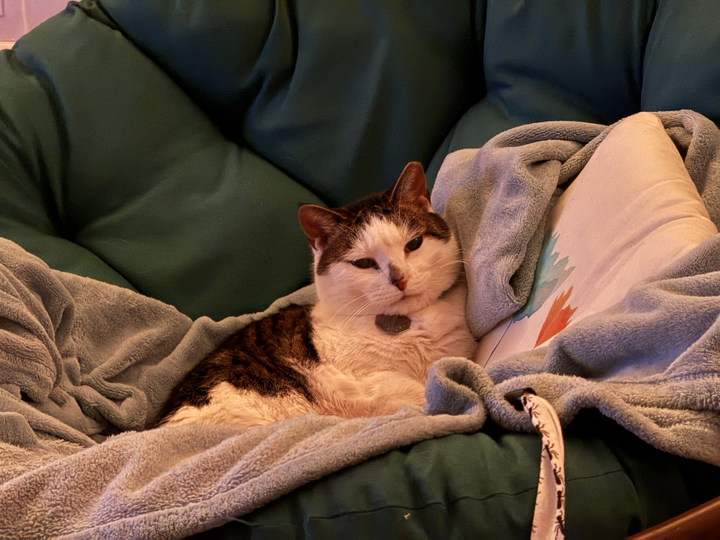
And now, your weekly Koko.

That’s all for now! See you next week with more sweet, sweet content.
In solidarity,
-Anna