My Job Is Becoming Illegal
On DEI work, academia, justice, and survivor's guilt.
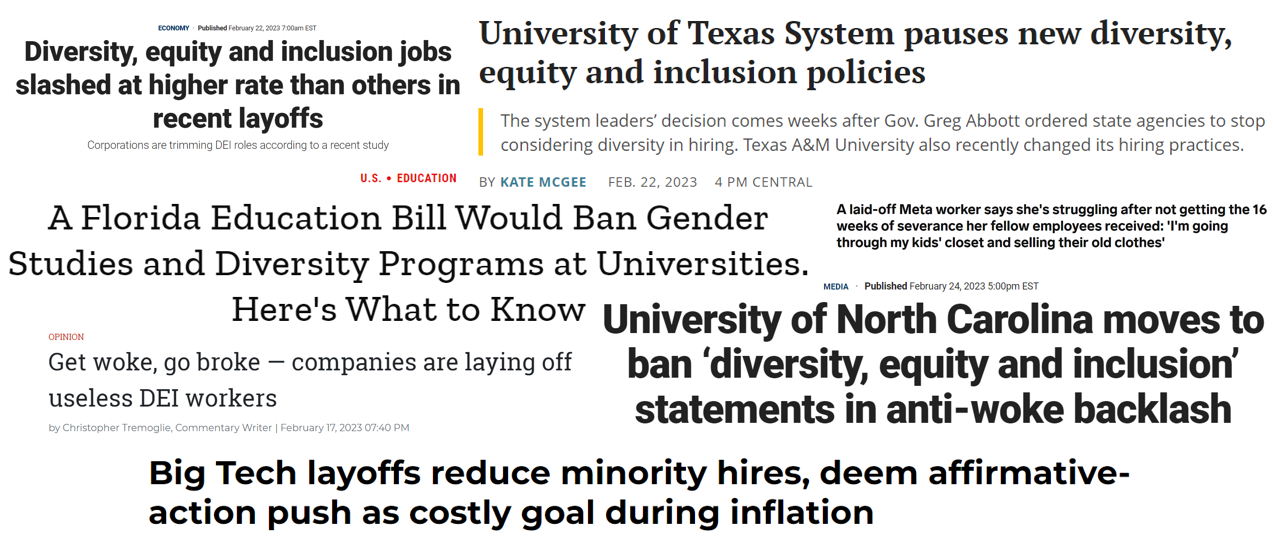
A big part of why I was hired at my current job was to engage in work so affectionately dubbed “DEI; diversity, equity, and inclusion”. And while my job is likely to remain secure here in liberal Massachusetts, it’s impossible for me to look away from the cuts being made to DEI programs across my own country, both in academia and elsewhere.
Here’s a lightning-fast history of “DEI” as a term. Efforts to diversify college campuses have been going on for as long as they’ve existed, but it wasn’t until the 1960s when “workplace diversity” became a stated goal of American corporations and universities. The “I” term (inclusion) started being introduced throughout the late 80s and 90s, around the time of the Workforce 2000 report which predicted a multicultural corporate landscape where women, “minorities”, and “legal and illegal aliens” would make up a larger portion of workers by the year 2000. For the past few years, the term “equity” has been added to make “DEI” the dominant term, and even more recently “JEDI” has emerged to include the term “justice”, giving such efforts a sort of directionality (“diversity to what end?”) Depending on how “in” you are at the current moment, you may have even heard terms like “anti-racist” or “decolonial” thrown around to describe one’s teaching practices.
And yet, despite decades of increasing the length of our acronyms and the frequency of our buzzword usage, workplace racism and sexism remain. Hundreds of college faculty have “decolonized their syllabi” and yet colonial land relations remain firmly in place. And worse, sense of belonging for the average student has not increased as much as we might have hoped.
“DEI work” is in an awkward position of being hated both by its critics and its supposed beneficiaries. College students have a complex relationship with DEI committees, often being roped in to do unpaid labor and (for example) explain anti-Black racism to non-Black faculty. At an institutional level, colleges love to flex their DEI efforts, forming DEI committees and even cultural centers, while also systemically underfunding and understaffing them, and then reprimanding them for meeting enough arbitrary metrics for inclusion.
One story I have from working at my UConn’s DEI office is illustrative here. Last June, I helped organize a free yoga hour for faculty, staff, and graduate students of color at the university. The event was lovely, with several Huskies of color showing up on a gorgeous, sunny summer day to stretch, breathe, and relax under the shade of a tree in our campus center. As they should; after all, it was the day following Juneteenth, a holiday signifying liberation for Black Americans. Rest is revolutionary. However, one hiccup occurred during the promotion of the event: I had advertised on the digital flyer that the event was meant for “BIPOC faculty, staff, and graduate students”, but we got pushback from university higher-ups for this upon posting this to the university-wide Listserv. The pushback came on the basis that our flyer implied that white people were not welcome at the event (they weren’t; even I was only present at the beginning and end of the event for setup/breakdown).
In the year 2022, we got slapped on the wrist for “not being inclusive to white people”. All we wanted was one hour (one hour!!) of yoga in the shade for non-white people on Juneteenth. But our Black faculty, staff, and graduate students can’t even have an hour of rest and recovery from this turbulent world without a white person having a problem with it. So much for that diversity training we all took.
Sometimes I ask myself, if Republicans only knew how little impact these college DEI programs have had, they would care less. If only they knew of the utter uselessness of the pizza parties, “community dialogues”, and solemn emails from university admins, from which no actual change emerges.
Of course, many DEI practitioners know all of this. Some have even named “The DEI Industrial Complex” to describe the very phenomenon I outline here. People like me do this work, as genuinely as we can, while holding in the back of our minds the fact that it’s mostly performative bullshit, and that we need to fundamentally change how our society operates if we truly want to have “equity” or “justice”. I myself am a begrudging user of the DEI acronym; I use it only because that is the word that I have to use in order to explain to people what I do. When I can, I do prefer “JEDI” at the very least, and when I’m truly saying how I feel, I use “abolitionist engineering education” (which has remained in my Twitter bio and website for years).
Abolition of what, you might ask? Well, I’d love to discuss that…
…but I can’t. At least not this week. Because even the microscopic progress we’ve made in diversifying our colleges and ensuring safe working environments for historically-excluded individuals is too much for modern Republicans.
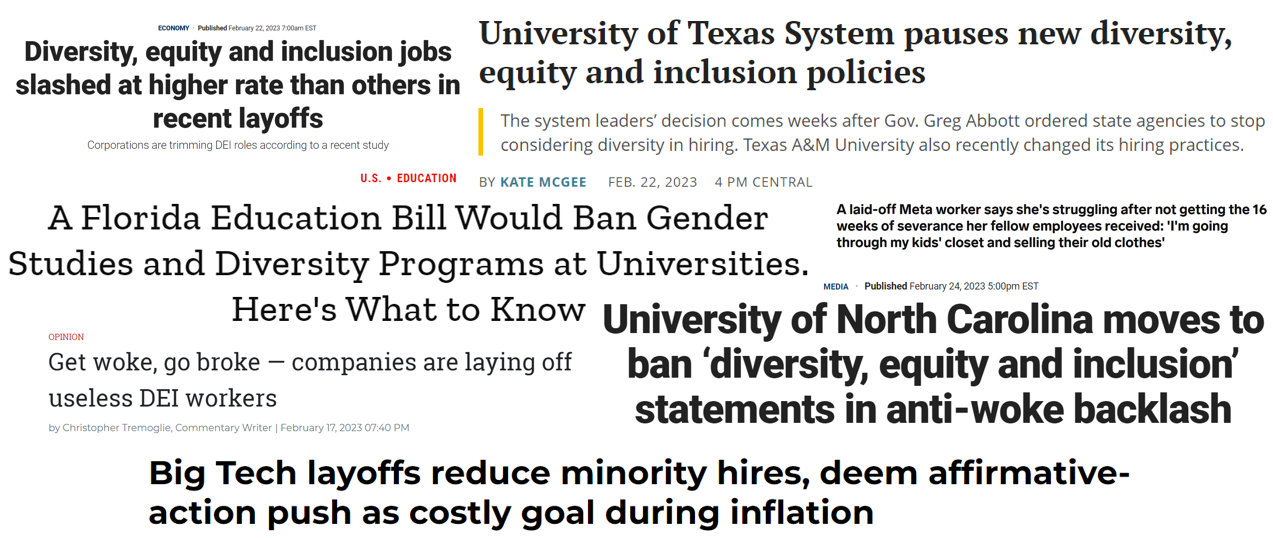
The Republican-led demonization of anything even vaguely progressive has resulted in an attack on education. Texas, Florida, North Carolina, and other states have begun rolling out sweeping cuts to college DEI initiatives as well as entire majors related to studying gender and race. This will inevitably lead to people of color and non-men getting fired from their jobs in the short term, and students of diverse identities having worse outcomes in the long term. This is, of course, part of their long-running scheme to defund public education in favor of private education (or no education).
All of this is happening at the same time as statewide bans on drag art, trans health care, and trans existence in general, coupled with insidious media coverage and misinformation on trans issues. All of this is happening at the same time as the Stop Cop City protests which have left multiple people of color murdered by police. All of this is happening at the same time as a rise in anti-Semitism, including a neo-Nazi-organized National Day of Hate on the day I write this very newsletter. (Nazis, far-right power, and anti-LGBTQ book burnings…where have I heard that before?)
This has, naturally, left me with Big Feelings.
This coming week, I will be giving two talks about the importance of social justice in STEM education. The first, here at UMass, will be a workshop to help Engineering faculty incorporate social justice themes and inclusive pedagogical practice into their teaching. The second, at my alma mater, will be all about why trans inclusion leads to better science. (If you’re at UConn on March 3rd, feel free to attend!) As a matter of fact, I have started to advertise my services as a speaker, and I have several other big talks on related topics coming up in 2023. (Side note: if you're have any position to set something like this up or recommend me for a speaker series, I would love to come speak at your company/college!!)
I am proud of the work that I do. I get to be a transgender chemical engineer and help my colleagues become more trans-inclusive and more justice-focused. I try my best to make sure that my work isn’t performative, it’s actionable and directly making diverse students’ lives better. I know that I am making a difference and I see the impact of that work all the time.
At the same time, I am wrecked with survivor’s guilt. I get to be a trans chemical engineer, while being trans in public is essentially illegal 1,000 miles away in Tennessee. I can discuss my opinions on social justice openly at my university, while at a peer institution in the South, the same opinions would get someone fired.
What does it mean to do DEI work in a world where DEI work is becoming illegal? How do we critique the DEI Industrial Complex from a healthy angle while also maintaining its importance in a hostile world?
…
I have my answer: get louder and push further. I have long believed that it is my responsibility as a white educator to say the things that an educator of color could be fired for; that has not changed one bit. The fact that this kind of speech is being suppressed only makes it even more important that we say it. I will not buckle. I will keep educating until I am dead and in the ground, and if someone wants to fire me for saying that marginalized students deserve better, so be it.
I came up with the term “abolitionist engineering education” because I saw the progression of “Diversity → D&I → DEI → JEDI” and I asked, “Well, what’s next? What is at the end of this progression? What is all of this in service to?” I encourage you all to keep asking questions like this.
My end game is not an acronym. It’s justice. What’s yours?
Currently Reading
- I’ve been following the Ohio train derailment story very closely. (I even made a TikTok about why PVC is poison.) More Perfect Union has done an excellent job covering why this disaster happened, documenting abusive working conditions at Norfolk Southern. The EPA is making them pay for cleanup, which is a great thing.
- At the same time, now we have to deal with the cleanup. Residents in East Palestine are still recovering, without meaningful support. There are also reports that vinyl chloride and other toxins from the accident are being found in places as far as Huntington, WV. Stay safe out there folks.
- We’re also now seeing the soil from the incident being brought to a certified treatment facility in Detroit, MI and water from the incident being brought to Deer Park, TX. Knowing my history, I immediately thought back to Warren County, NC, the birthplace of the environmental justice movement, where in the 1980s contaminated soil from PCB byproduct-dumping was brought to a majority-Black neighborhood, sparking weeks of nonviolent protest. I can only hope that this contaminated soil and water will be treated effectively and NOT dumped on people of color, but I will watch this closely as well.
- Unrelated, but this op-ed meant a lot to me: “Everyone Is Beautiful And No One Is Horny” by R.S. Benedict. I love me some cultural commentary, and this really did it for me. Screw beauty standards, be gross!
Watch History
- Rebecca Watson does an excellent job at combating right-wing misinformation, including this video about the right-wing attack on *checks notes* regulations for gas stoves. This story truly shows the power of “woke” as a catch-all buzzword for anything good in the world, including helping everyday working-class American lives.
- Another possible contribution to my Polymer Processing class: an anti-capitalist take on why every product you buy is of lower-quality than it was just a few years ago. (Hint: it’s not ALL because of plastic, although partially it is!)
- An excellent video on why not to become a content creator. As a content creator, I endorse this message.
Action Items
“Stop Cop City” protests are emerging all the time across the country, and you can get involved too!
Don’t forget to buy your cookies from some trans Girl Scouts starting February 27th!
Bops, Vibes, & Jams
- The new Gorillaz album met and exceeded my expectations. Fav tracks: the Stevie Nicks collab, the Adeleye Omotayo collab, the Thundercat collab, and screw it, “Skinny Ape” too.
- Caroline Polachek’s “Desire, I Want To Turn Into You” is very good front to back. The way she uses her voice as an instrument is enchanting.
- I’m thrilled to share that the new Rebecca Black album is incredible. Fav tracks: “Misery Loves Company” and “Sick To My Stomach”.
- Real ones know that Sabrina Claudio is my favorite R&B artist. <3
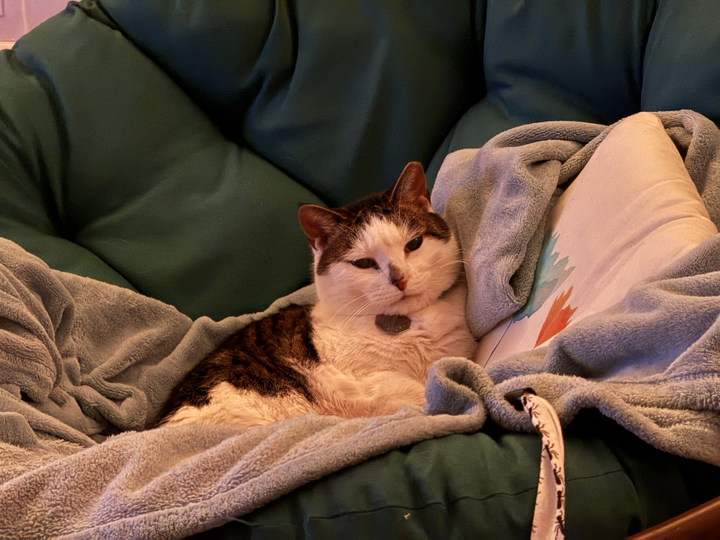
And now, your weekly Koko.

That’s all for now! See you next week with more sweet, sweet content.
In solidarity,
-Anna