Engineering Jobs, But For Women!
On being glue, robotics teams, and gendered labor.
FIRST Robotics Competition is a sports league for high school students who want to get involved in engineering. It’s a fantastic program where students build working robots with the goal of accomplishing a different team-based sport every year. Some are as simple as “soccer, but with 120-lb robots” and others are as complex as “score points by launching frisbees while also climbing a pyramid and also there’s a period at the start of the match where your robot has to work to autonomously collect frisbees.” It’s challenging and exhilarating and I’ve made lifelong friendships through the program.
During my time in high school, I did FIRST Robotics all four years. It was in my high school’s metal shop that I learned to love engineering, it was there that I got guidance from volunteer mentors on how to think like an engineer, and it was there that I shouted with joy that I got into UConn’s Chemical Engineering undergraduate program.
My involvement in the team was not random. My parents moved to this particular town because of its strong STEM program. I had thus always been a nerdy white boy who hung out with other nerdy white boys. My sister had even been on the robotics team before me. It was destiny, or at the very least the inertia of society’s decisions for me. Nature or nurture, take your pick, all paths led to me becoming an engineer.
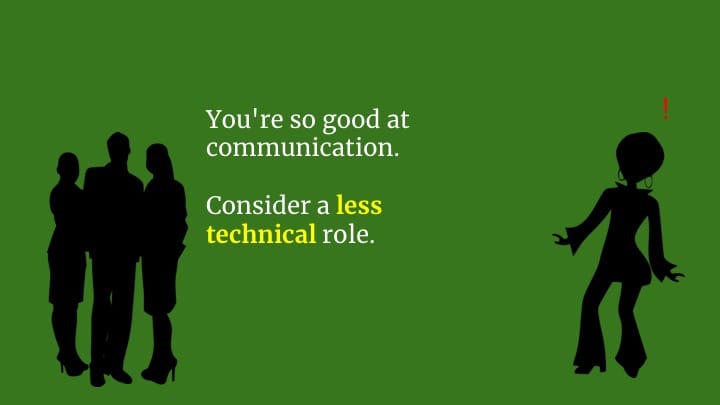
In those four years, there was a pretty clear gender divide amongst the team. With only a few exceptions, boys were in charge of making our robot, testing out different parts and strategies, operating the robot during matches, programming the robot for autonomous mode, etc. And with only a few exceptions, the girls (and those assigned female at birth who would later come out as trans and/or non-binary) were in charge of the other business; making signs for us to hold up when we were in matches, sewing together the outfit our team’s mascot, or writing the essays that would win us awards (such as the coveted Chairman’s Award).
Basically, boys did the technical work and girls did the creative and business work. Intentionally or not, we had replicated the structure of many STEM workplace environments. While being on a FIRST Robotics Teams is supposed to empower kids to pursue a career in STEM, it is unsurprising that all of the boys (and former boys) on my team now have jobs in STEM, while all of the girls (and former girls) do not.
When I was a boy on this team, I was enlightened enough to be aware of this discrepancy, but not brave enough to speak up or do anything about it. More boys are like this than we think. Not that it changes much.
I’m no longer the nerdy boy I was in high school, unsure of his place in the world; I’m a nerdy woman, post-grad school, and very sure of her place in the world. I’m a teacher at the undergraduate level, and because I teach Seniors, I’m always on the lookout for new and exciting STEM career paths so I can make my students aware of them.
Once you get a Bachelor’s degree in chemical engineering, the majority of your options are working for Big Chemical Company A or Small Startup B. Back at UConn, the most coveted positions were at places like United Technologies Corporation, Unilever, Eastman, Henkel, General Electric, or Alexion. Just as many of my friends from college went on to work for lesser-known startup companies in pharmaceuticals, biotech, plastics, or other very cool industries.
But there are lesser-known options too: you can become an engineering consultant. You can go to grad school and become a higher-level researcher than you could with just a Bachelor’s. There are even a multitude of other non-technical jobs for which an engineering degree would be useful. You can pursue a second degree in environmental law. You can go into patent law. You can even can become a technical salesperson for a company that makes engineering tools. (The saying goes that a good TV salesman doesn’t need to know anything about a TV to sell it to you, they just need to know about you, since their goal after all is to manipulate you into buying something. The same doesn’t apply to engineering, where a salesperson should probably know everything about the product they’re trying to sell, especially if that product is a bandsaw, PID controller, reciprocating pump, or plate heat exchanger.)
But here’s the thing: you can only pursue a career in something if you’re aware that that field exists in the first place. And for many women and historically-excluded students in STEM, most don’t know what their options are, due to a systemic lack of connections and knowledge.
Which is why I was delighted to hear that one of my TikTok mutuals was leaving engineering to pursue a job as a technical writer.