Asking For Help
On professional advice, Halloween lectures, and how to give me money.
“You can just cold-email professors!!” I state plainly to a room full of students. I’m on panel for undergraduate chemical engineering students who are interested in going to graduate school, an event ran by UMass’ AICHE chapter every Fall.
One of the students had asked what they should be doing now to prepare for graduate school. The best, most prescient answer to which is, of course, do undergraduate research. Actual lab experience will not only give you the technical skills that are good to have before grad school (pipetting, titration, coding, whatever techniques/instruments are most relevant to your particular sub-field of STEM), but it will expose you to mentoring opportunities, let you develop higher-order skills like experimental design, and even help determine what sort of research questions you have before you even apply to grad programs. It is all-around a great thing to do if you’re at an institution that lets you, and I make that abundantly clear to nearly every undergraduate that I meet. I also make it clear that I didn’t do undergraduate research, and that I regret it, and that I probably only got into grad school because I got lucky; if you know you want to go to grad school, you should essentially treat it as though it’s a requirement.
But this raises another question: how do you find a research lab you want to work for? And within that, how do you ask a faculty member to be a part of their lab? This was when I had made my declaration about cold-emailing. It was also the stickiest part for most of the students at this AICHE panel, the part that made the freshman and sophomores in the audience shift in their seats and look at each other awkwardly . In all the panels like this I’ve ever been on, and every single time I mentor a student who wants to go to grad school, the mere thought of reaching out to a prospective PI that they don’t have much of a relationship with makes them uncomfortable. “Are you sure? You can really just do that?”
I definitely empathize with this response. Despite my undergraduate instructors being prima facie very kind, nothing in my education had prepared me to walk up to one of them and ask about joining their lab. Particularly for those who I didn’t know that well, it felt like making a demand; “hey, person with a PhD and decades of experience who probably doesn’t even know my first name, please let me tinker with your expensive equipment, because I wanna!” If you’re an introvert or just don’t have a lot of confidence, it’s hard to know where to begin.
At the panel, we ended up getting into the nitty-gritty of it all; how to go on the department website and look through different faculty member’s project interests, how to write a professional-sounding email, if you do meet with a faculty member what sort of questions you should ask, what your first semester of research might be like, how you can try a few different labs to find what your personal interests are, and how to work your way up to having your own independent project and/or have a publication under your belt before you even graduate (pretty much a golden ticket into a PhD program). But the social dimension of “asking for help is scary” can’t be ignored either.
I made it very clear at that panel that even through I don’t have a lab of my own right now, I am always happy to mentor students. “Always feel free to reach out to me”, I roughly said, “In fact, if you want to meet with me, you don’t even need the excuse to be that you’re looking to go into grad school and want advice; if you just want to chat with a queer, trans, gender non-compliant dyke who is also a chemical engineer, just reach out!!” This was my messy way of saying “hey, LGBTQ+ students in the audience, my office is your home, I am here for you”. (It was past 6pm and my brain was fried, gimme a break.)
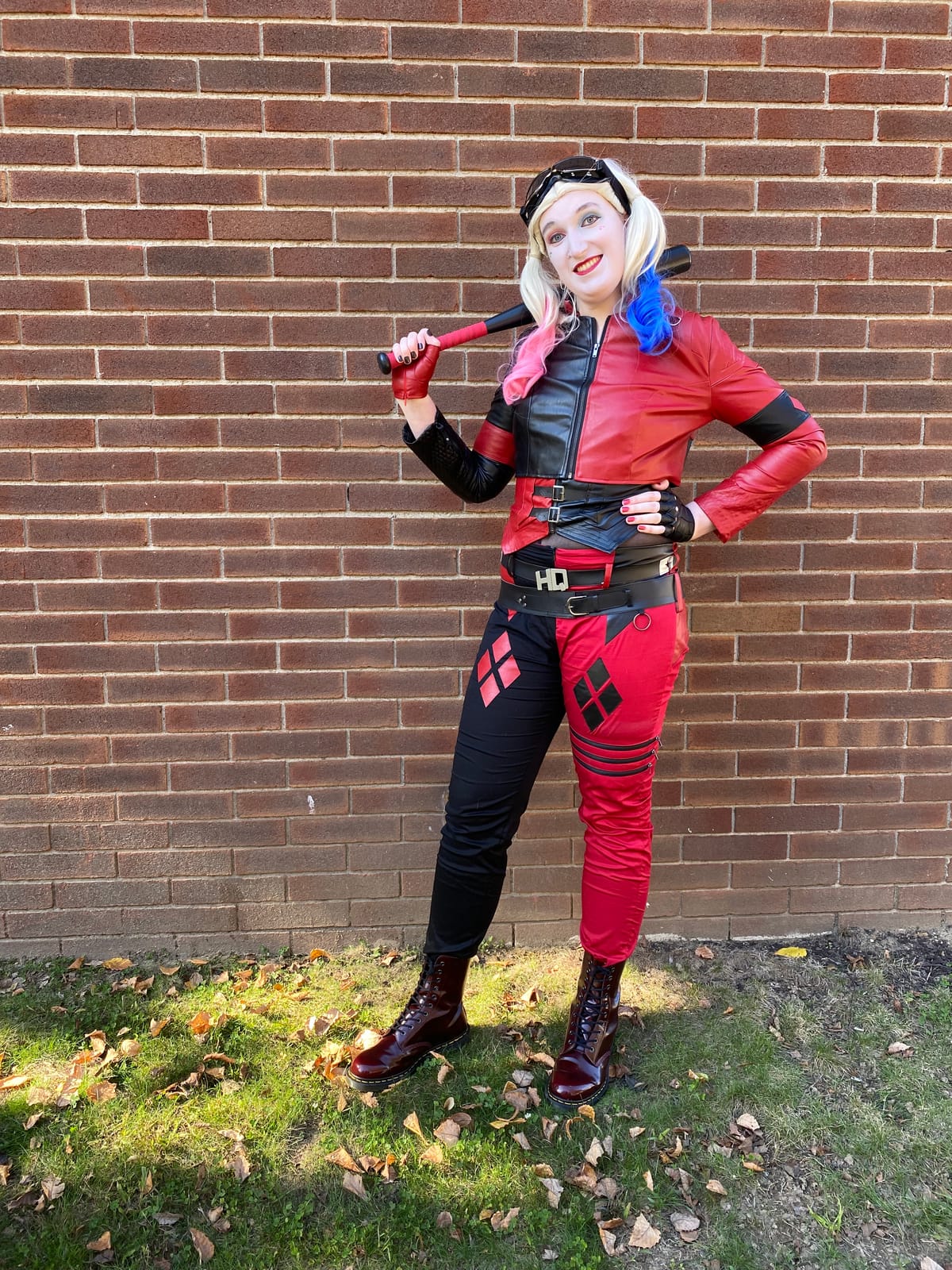
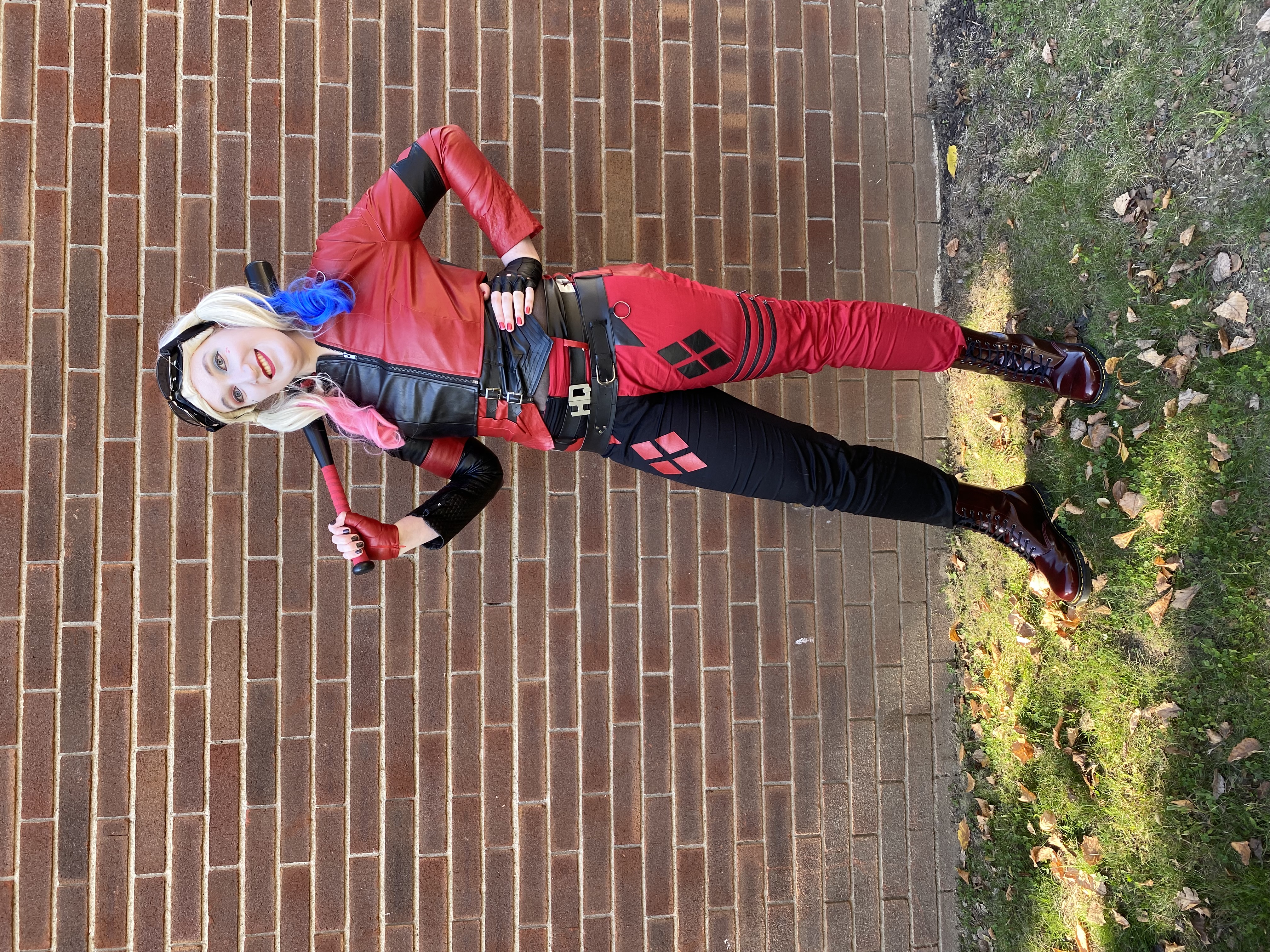
This particular piece of advice about asking for help is important to me, so I brought it up again the following week when I gave my Halloween lecture in-character as Harley Quinn. Yes, really. On Friday, October 28th, after the planned lecture about process control instrumentation, “our guest lecturer Dr. Harleen Quinzel” ended with some positive affirmations for the ChemE Seniors in my Process Control class. This included advice about cold-emailing professors for recommendation letters if you need them, writing your own rec letters in a way that avoids gendered bias, and phrases that’ll help these future workers (especially the women in the class) be assertive and confident in their future jobs. “Harley” did all this student empowerment while bouncing around the lecture hall, handing out candy, and swinging a bat around. (Side note: I love my job.)
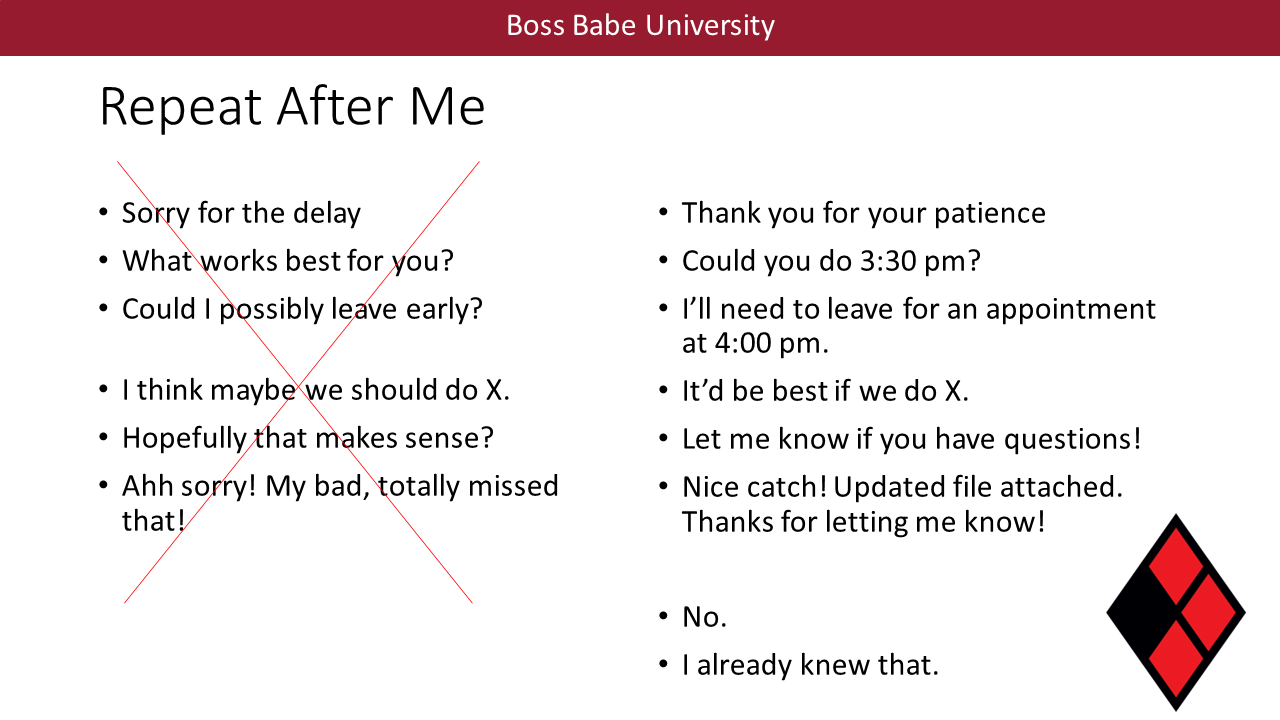
Instructors shouldn’t ignore the social dimensions present in their classrooms. Not all students have the social skills to simply ask for help with an assignment, or walk up to a prospective PI and ask to be in their research lab. It’s on us to be as clear as possible that we are a resource for them, and to provide a clear mechanism by which they can seek help (see: having office hours but students don’t know how to best utilize them). Otherwise, students won’t get the help they need until it’s too late.
…
Naturally, over the past few days I’ve thought a lot about mentoring, the nuances of asking for help, and even how well I’ve followed my own advice. Asking for help is hard, and I’m often scared to do it myself. But even when you don’t know how to ask for help, or who to ask for help from, there’s something to be said about manifesting, the idea that putting your wants and needs out into the universe for them to be heard can (and often does) result in something great happening for you.
So, here goes nothing.
Since this has been such a fulfilling hobby for me, I’m fully leaning into content creation. If I’m putting out amazing TikTok videos, producing journalist-quality podcasts, hosting talks and panel discussions about being #TransInSTEM, and (dare I say) writing high-quality newsletters on a regular basis, I may as well be paid for it, right?
There’s gonna be some changes around here. From now on, this newsletter will be biweekly, instead of weekly. Also, there will be a biweekly, paid version of this newsletter where I give my spiciest takes about trans issues and the latest academic gossip. Who knows, I might even share cute selfies? You surely won’t want to miss it *wink*.
This $5/month subscription is also a means by which my audience can support me in everything that I do, from my video content to my podcast to this newsletter you’re reading now! I also have a Cashapp ($ThatAnnaMarie) if people want to make a one-time donation to help me out financially.
Consider becoming a paid member of the newsletter today! You won’t regret it!
Currently Reading
- This week in “duh!!”, a publication showing that professional organizations like NSBE and SWE help improve student retention and sense of belonging in engineering programs. Take that, systems that want to obstruct student support!!
- We’re already a week or so into Elon Musk’s takeover of Twitter, making this Atlantic article from 10/27 already feel a bit outdated. However, it points out that Twitter’s decline may be more mundane than a series of terrible decisions made by Elon; he could simply get distracted by another shiny object and leave it behind with his many other projects, neglected and operating at a loss. (Tbh, that’s the best case scenario at this point.)
- For a fresher take on Elon’s takeover, Dr. Casey Fiesler has been doing a lot of coverage about the changes at Twitter as well as how online communities are going to restructure themselves without the bird app. (Side note: I have a Mastodon now! Find me at ThatAnnaMarie on mstdn.social!)
Watch History
- Two of my favorite Halloween specials of all time: (1) Laura Crone’s enrapturing story about haunted houses and consent, and (2) CJ the X’s analysis of what makes Coraline so spooky.
- An excellent analysis of why queer TV is getting worse. In a similar vein to my latest podcast about recommendation media, there is an overabundance of queer TV, it’s just that it’s terrible, not marketed very well, and gets cancelled before its prime.
- Jessie Gender contrasting the newest Lord of the Rings and Game of Thrones prequel series better than anyone else I’ve seen do it.
Bops, Vibes, & Jams
- Taylor Swift supremacy is real, y’all. I even had the gumption to produce content about it; disgusting.
- Leikeli47’s newest album is stunning (pay no mind to the fact that I’m getting to it 6 months late)
- I adore the jazz-rap stylings of Mia Gladstone, and I definitely love seeing women self-producing their own music. Give this awesome collab album a listen!
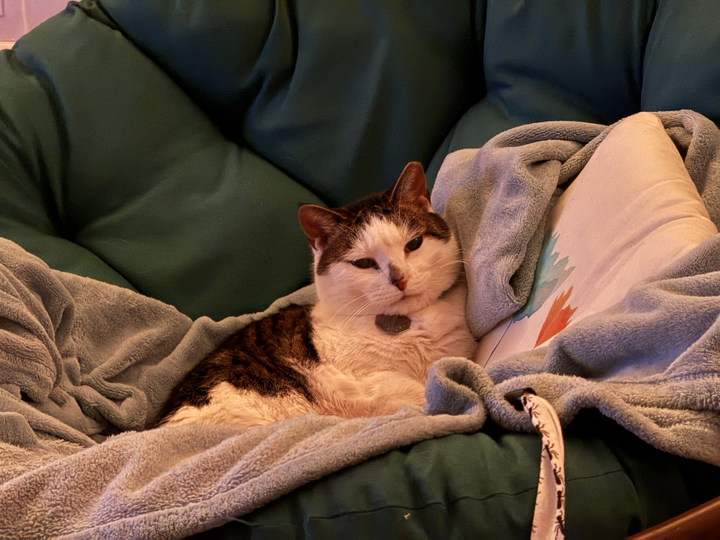
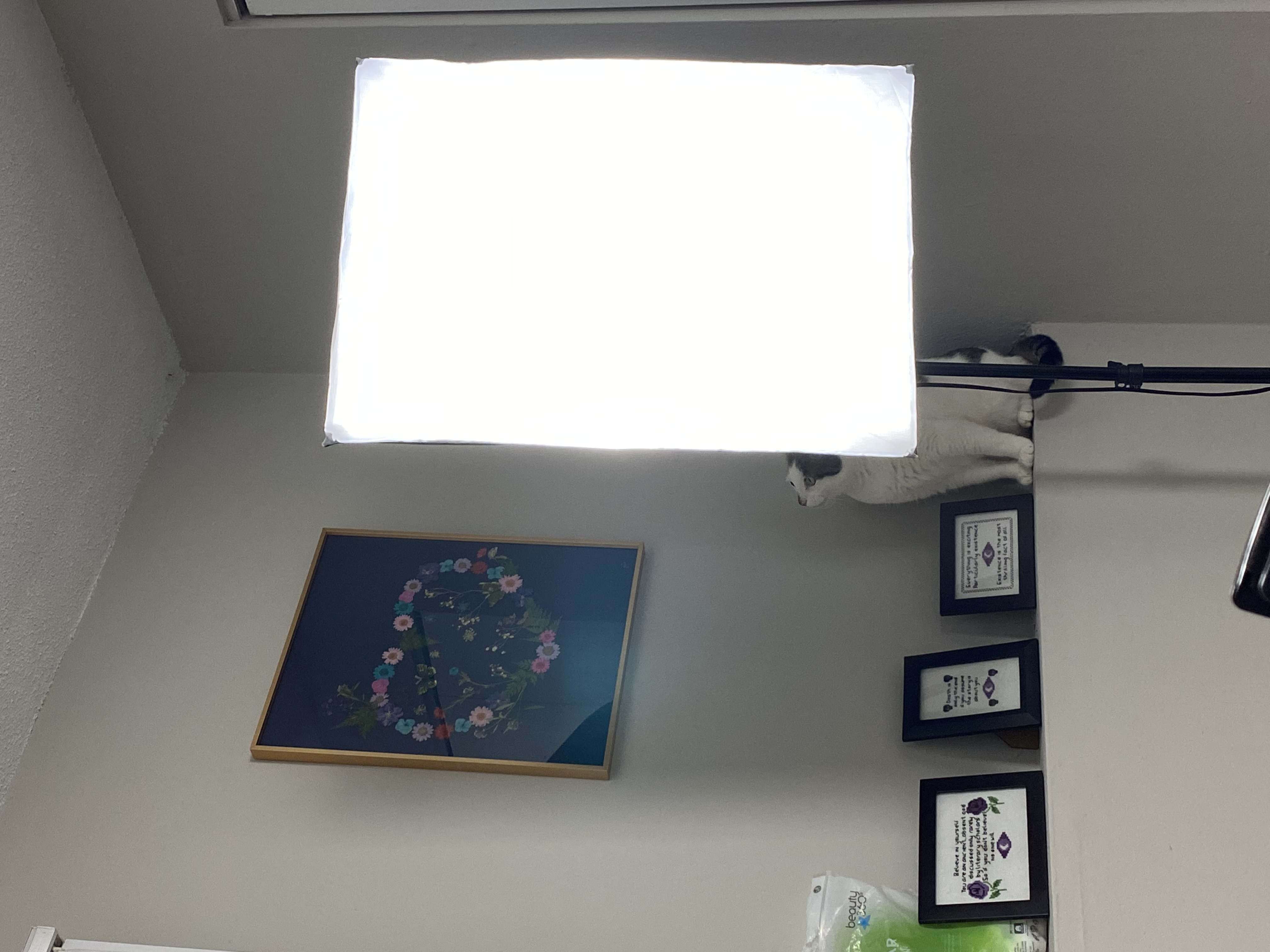
And now, your weekly Koko.
That’s all for now! See you next week with more sweet, sweet content.
In solidarity,
-Anna