A Famine of Media Literacy
On green chemistry, global events, and how to read the news.
This past week in my Green Chemistry course I decided to have my students do an exercise in media analysis. Despite the fact that I was teaching graduate students in STEM, people who should be excellent at critical thinking, it went…okay.
If you weren’t aware, earlier this year the EPA proposed new restrictions on the use of methylene chloride, a solvent used in paint strippers and the manufacturing of some pharmaceuticals and refrigerants. The chemical causes extreme harm to workers, including nervous system damage and cancer, hence the new restrictions, which include much lower OSHA exposure limits than previously instated. In general, the use of volatile and toxic solvents is a green chemistry no-no; there’s an entire Green Chemistry Principle (#5) devoted entirely to solvent use since they’re incredibly harmful to workers, result in a lot of chemical waste that has to be separated downstream (which requires massive amounts of energy, which means fossil fuel use), and contribute heavily to smog formation.
If you read about the environmental, health, and safety impacts of methylene chloride, limiting its use (if not banning it entirely) seems like a no-brainer. However, most chemists and chemical engineers aren’t exposed to this information. Rather, they’re exposed to articles like this one from Bloomberg Law, with headlines like: “EPA Solvent Rule Said to Signal Hurdles Ahead for US Industries”.
The article spends about one half of a sentence on the toxicity of methylene chloride, simply calling it “potentially deadly” before spending the next 1,000 words on the concerns of the chemical industry (derogatory). Specifically, concerns about how harsh the bans are, how the proposed rules are more strict than other countries, how difficult the rule would be to enforce, how little time they’re being given to transition away from the solvent (~15 months), how the rule might impact supply chains, and how this might cause a domino effect leading to the ban of other solvents like perchloroethylene (another carcinogen that causes nervous system damage).
I’d like to stress that these concerns have some validity—it will definitely take some effort by engineers to figure out how to transition away from this chemical—but as critical media consumers, we must ask questions like: “What argument is the article making about the new solvent rule? What does it say about the author that so little time is spent on the toxicity of the solvent, while much more time is devoted to sharing perspectives of industry-heads who think the bans are unreasonable, or too much too soon?”
To be clear, this article didn’t lie about anything; everything presented here is 100% factual. However, the media-illiterate (and/or the heavily-biased) might read this article, take it at face value, and come away with a particular opinion about the solvent rule, based entirely on which facts were presented and which facts were omitted.
So, I gave my students a second article to read. This Washington Post article (sorry about the paywall, UMass students can access it for free) also talks about the solvent rule, but from a different set of perspectives. It includes voices from EPA Administrator Michael Regan, the mother of a worker who lost his life to methylene chloride exposure, and even activist group Earthjustice who say the rule is a great first step but that an outright ban is needed. The article also places the new rule in historical context, elaborating that the new solvent rule is the result of a new extension of the Toxic Substances Control Act from 2016 (during the Obama administration), which was then rolled back a bit under Trump in 2019, and is now being pushed further under Biden, implying that this new solvent rule has been a long time coming. Most importantly, it actually spends time explaining the toxicity of the chemical in simple terms, including the reality that even workers who wear the appropriate PPE can still face deadly levels of exposure.
Here are some notable key quotes from the second article:
- “can poison the nervous system”
- “exemptions in the rule would allow certain uses of methylene chloride to continue for a decade or more, leaving workers, service members, and communities at risk”
- “would go much further than past efforts, though it falls short of a total ban some health groups have called for in the past”
- “‘No mother should have to face that,’ Hartley said of her son’s death.”
Compare these one-to-one with phrases from the first article:
- “Supply Chain Impacts”
- “bans likely to challenge industries”
- “[the proposed limits are] less than the limits in some other industrialized countries”
- “[the] EPA has not established the necessity to set an additional, independent, occupational exposure limit in addition to those already in place.”
Even just the difference in headlines and subheaders tell completely different stories.
“EPA Solvent Rule Said to Signal Hurdles Ahead for US Industries; Worker exposure limits, bans likely to challenge industries; Perchloroethylene proposal expected next”
“EPA proposes to ban most uses of methylene chloride, a toxic solvent; Used as a paint stripper, methylene chloride can poison the nervous system and is the second chemical the agency is targeting under a 2016 law update”
The point of my little lesson is this: it’s only by placing these two articles in conversation with each other that we’re able to get the full picture. Reading each article alone might tell you facts about the new EPA rule, but it’s a lot easier to see the arguments that each article is making when you have an understanding of both “sides”. With both articles in mind, the first article shows just how much the chemical industry seems to fold its arms and kick its feet at the idea of implementing greener chemistries, as well as just how much the forces of profit-driven capitalism motivate the industry. Engineers do need to confront the reality that, yes, green chemistry is difficult and it will take time and effort to transition the industry away from toxic chemicals. At the same time, they should also acknowledge that we must make this transition for the good of humanity, and that we should constantly be pushing ourselves to go further and further at protecting human life.
In short, I got my students to read this two articles about the same situation from two different perspectives, and through a discussion of both, we were able to synthesize the “truth” of the situation and assess what “arguments” both authors were making. I asked questions like, “What motivations does each author seem to have? Which article seems to be more pro-worker? What does this say about how the industry talks about itself (vs how outsiders talk about it)? What does this tell us about how green chemistry is implemented at a massive scale?”
My students seemed to understand the importance of this activity, but one follow-up question I asked seemed to make them shift in their seats with guilt. I asked if they did this sort of thing regularly—compare two sources of information side-by-side to synthesize truth—and none of them said yes. I even asked, “Where do you all get your news from?” and the answers haunted me.
- “Twitter”
- “the Google homepage”
- “Facebook and Instagram, I guess”
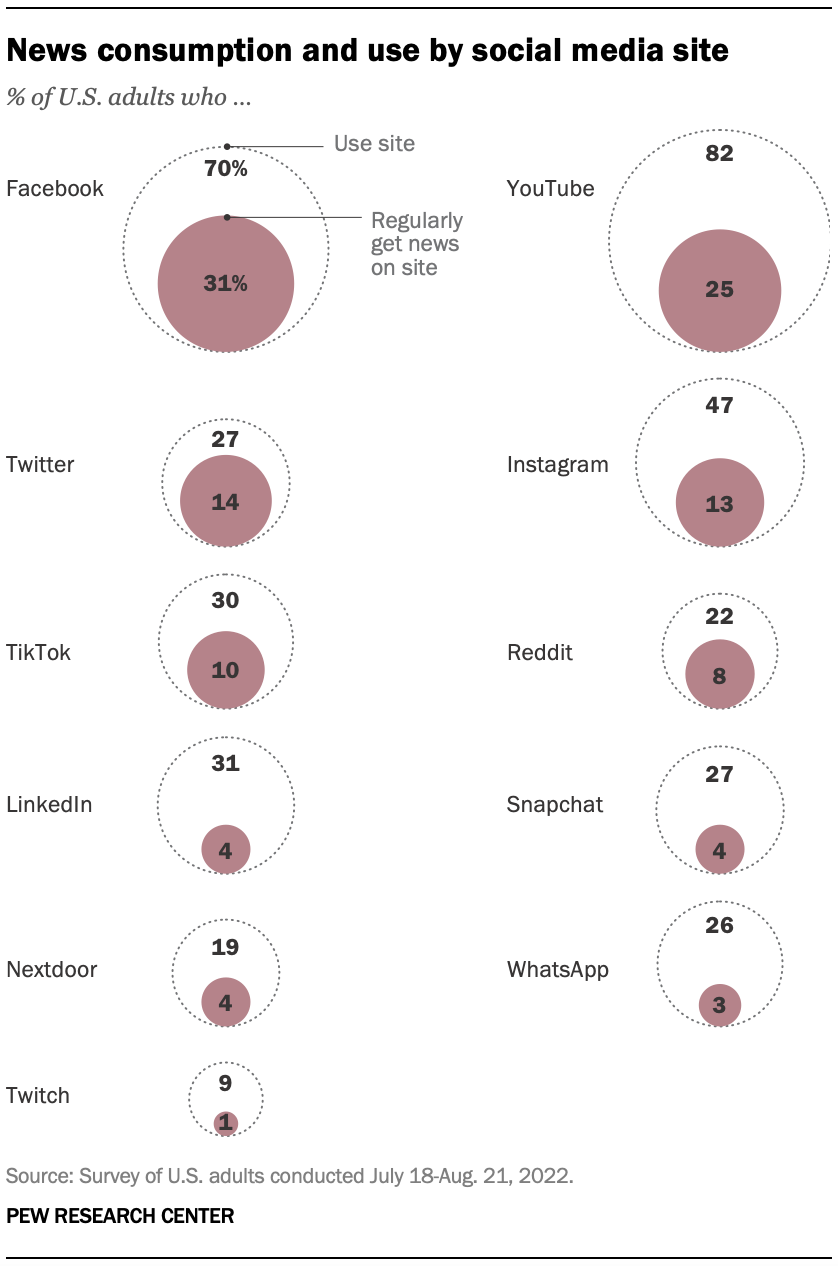
All of my students get their news from algorithmically-curated sources. I guess this shouldn’t have surprised me that much, since at least half of U.S. adults get at least some of their news from social media. Maybe I just expected better from PhD students, who are training to be able to research topics with some degree of academic rigor. No shade to these students—it’s difficult to find reputable news sources and readings many sources just to find a simple answer can be time-consuming. My worry is about the disconnect between the different realities that we’re living in.
Imagine a world where people within the chemical industry only read news written by and for the chemical industry, like this Bloomberg Law article, and people outside the industry (toxicologists, climate activists, and the general public) only read articles about how the chemical industry is killing the planet, like this Washington Post article, and the two groups never exchange ideas or even cross paths. Actually, scratch that, I don’t have to imagine that world, because that’s the world we’re already living in.
Despite recent advancements towards interdisciplinary research, we’re still at a point where different fields of study can be completely siloed off from one another. Chemical engineers almost never talk to toxicologists; I might be the first in my department to establish a connection between ours and the Environmental Health Sciences department, who here at UMass literally have their offices one floor above ours. Polymer scientists are often unconcerned with plastic pollution, and when they are, they’re invested in researching remediation strategies like recycling rather than challenging the root causes of pollution (capitalism & colonialism).
This is my work as someone who lies at the center of these two worlds, who works at the intersection of STEM and social justice. What I can tell you is, we need more people who can talk to both engineers and activists. We need more people who can bridge the gap between the chemical industry and the people whose lives they’re destroying. We need more people power, more worker power, to keep the petrochemical industry from making the world uninhabitable. And most of all, we need more media literacy all around—among engineers and everyday people—to be able to combat these problems.
I care deeply about media literacy, having performed numerous analyses of popular media myself and having written about anti-trans media bias numerous times on this very newsletter.
And I dunno, something about this past week has got me to care a lot more about media literacy than normal…
Let’s start here: As a white American who has never so much as set foot in the Middle East, you should by no means look to me for advice on the Israel-Palestine conflict. For most of my life, the conflict has been in the periphery of my political world, which reflects my extreme privilege as a person living within the imperial core who benefits hugely from violence overseas simply by living in the country I’m in. The main reason I can type this newsletter comfortably from my home in Massachusetts, a home that has never in my country’s history been under threat of bombing from a foreign power, is because of the hard work of American imperialists and colonizers keeping underdeveloped countries from self-governing. While I have learned a lot about settler-colonialism from Indigenous people here in America and from some African scholars over the past few years, I am no authority on how this translates to Palestinian liberation or what that would entail.
With that out of the way, let me not bury the lead any further: It’s “Free Palestine”, it’s always been “Free Palestine”, and it’s always gonna be “Free Palestine”.
Despite the limitations of my perspective, it should not take any background knowledge on geopolitics to condemn a genocide. What Israel is doing to Palestine is a genocide, in fact is has been for a very long time, and it reflects an ideology of settler-colonialism. Palestinians have been dehumanized, persecuted, and directly murdered by Israeli people on the basis of being Palestinian. Palestinians have fought back, as is their right according to international law, but the conflict is very one-sided considering that Israel (1) has the power to shut off their water and electricity, thanks in part to previous colonial violence enacted by them, and (2) has the support of the American military, the largest military in the world and it’s not even close.